What to Expect at a Beach Volleyball Camp: The Full Day-by-Day Schedule
If you've never been to one of our camps, the schedule is probably the biggest question mark. I get it — you're flying somewhere, taking days off work, and you want to know exactly what you're paying for. So here's the full day-by-day schedule of a Better at Beach camp, from the first morning huddle to the last game on the final day. Whether you call it beach volleyball or sand volleyball — as it's called across much of the country — a camp is really just three days of concentrated lessons with a coaching staff watching every rep.
What does a beach volleyball camp schedule actually look like?
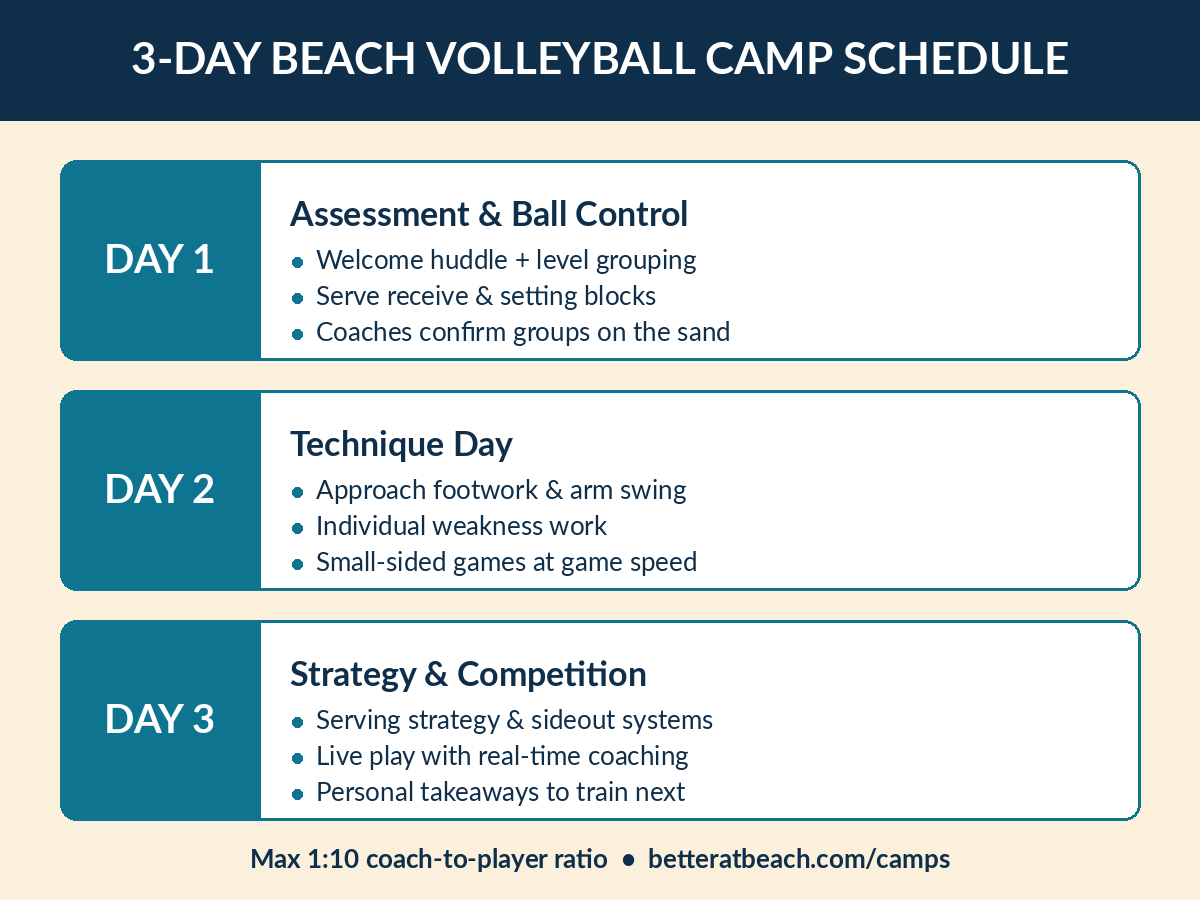
A 3-day beach volleyball camp runs morning and afternoon training blocks each day: Day 1 is skill assessment and ball control, Day 2 is technical work on your attack and individual weaknesses, and Day 3 is strategy and live game play. Every session happens in small groups — we cap our coach-to-player ratio at 1:10 — so you're never standing in a line waiting for touches.
Camp logistics are by far the most common questions our support inbox gets — schedules, hotels, what to bring — so this post lays out the whole thing the way I explain it to every camper who books a $599 3-day camp.
What happens on Day 1?
Day 1 is about two things: finding your level and fixing your ball control. We start with a short welcome huddle, then run everyone through structured touches — serving, passing, setting — while the coaches watch and sort players into level-matched groups. If you've been stressing about which level to pick when you registered, stop stressing: we confirm groupings on the sand on Day 1, and we can move you if the first session shows you belong somewhere else.
The rest of Day 1 lives on serve receive and setting, because nothing else in your game works if the first two contacts don't. Here's the kind of serve-receive coaching we run in that first block:
You'll finish Day 1 tired in the best way — your legs will know they spent a day in the sand.
What happens on Day 2?
Day 2 is technique day. This is where the small groups earn their money: each coach works their group through attacking — approach footwork, arm swing mechanics, shot selection — and starts attacking each player's individual weaknesses. By the end of Day 2 you should have one or two specific mechanical changes with a clear cue for each, not a vague "hit better."
This is the same arm-swing work we do at camp, so you can preview it before you arrive:
Day 2 usually includes controlled small-sided games in the afternoon so you can test the new mechanics against a live block and real serves — but at game-like speed, not tournament pressure. That comes tomorrow.
What happens on Day 3?
Day 3 is strategy and competition. Morning: team systems — serving strategy, sideout options, defensive schemes, and how to scout an opponent in the first three rallies. Afternoon: live play, with coaches calling timeouts to coach situations in real time. This is most people's favorite day, because everything from the first two days shows up in actual points. We close with individual takeaways: every camper leaves knowing the two or three things to train next.
What about hotels, evenings, and getting around?
Once you book, you get an onboarding email with everything: exact meeting spots and times, recommended hotels near the courts, what to pack, and an invite to the camp WhatsApp group. The WhatsApp group is where the magic happens — campers coordinate dinners, share rides, and usually organize free-play sessions in the evenings. Accommodations and travel aren't included in the camp price, which is how we keep a 3-day camp at $599 — you control your own travel budget.
How many players are there per coach?
Our cap is 12 players per coach, in writing, and we staff to aim for 10 or fewer. Small groups are the entire point of paying for a camp instead of grinding it out alone: $599 for three full days of coached training works out to roughly what 8–10 private lessons would cost, except you also get level-matched partners and live game play to apply it all.
If you want a coach's eyes on your film specifically, video analysis is available as an optional add-on — a coach records and breaks down your play individually. It's not included in the base price, but campers who add it tend to leave with the clearest picture of their game.
How should you prepare — and what happens after camp?
The players who improve the most at camp are the ones who show up with their skills already warm and keep training after they fly home. That's why the best setup I've seen is membership plus camp: train inside our online membership before you arrive, use camp for the immersive coached reps, then go back to the membership to lock in the changes. My complete skill courses — serving, passing, attacking, all of it — are inside the membership, and a $1 trial gets you all of it for 7 days.
We've covered how to prepare for camp and whether camps are worth it in other posts if you're still deciding.
Ready to see a camp schedule from the inside?
Three days, small groups, a coach who knows your name and your arm swing by lunchtime on Day 1. Pick your dates and location on our camps page — think of it as a multi-day set of beach volleyball lessons and classes, compressed into one trip.