Indoor Player Adding Beach Volleyball: The Second Recruiting Path (2026 Guide)
If your daughter or son is a solid indoor player — club team, decent tape, coaches who like them — you've probably already discovered how brutal the indoor recruiting math is. Thousands of club athletes compete for the same rosters. What far fewer families realize: there's a second recruiting path running right alongside the first one, on the sand. I've coached indoor players making that jump for years, and this is the honest version of how it works — beach volleyball (sand volleyball, if you grew up in Texas or the Midwest) as a recruiting strategy, not a hobby.
Can an indoor player switch to beach volleyball for college recruiting?
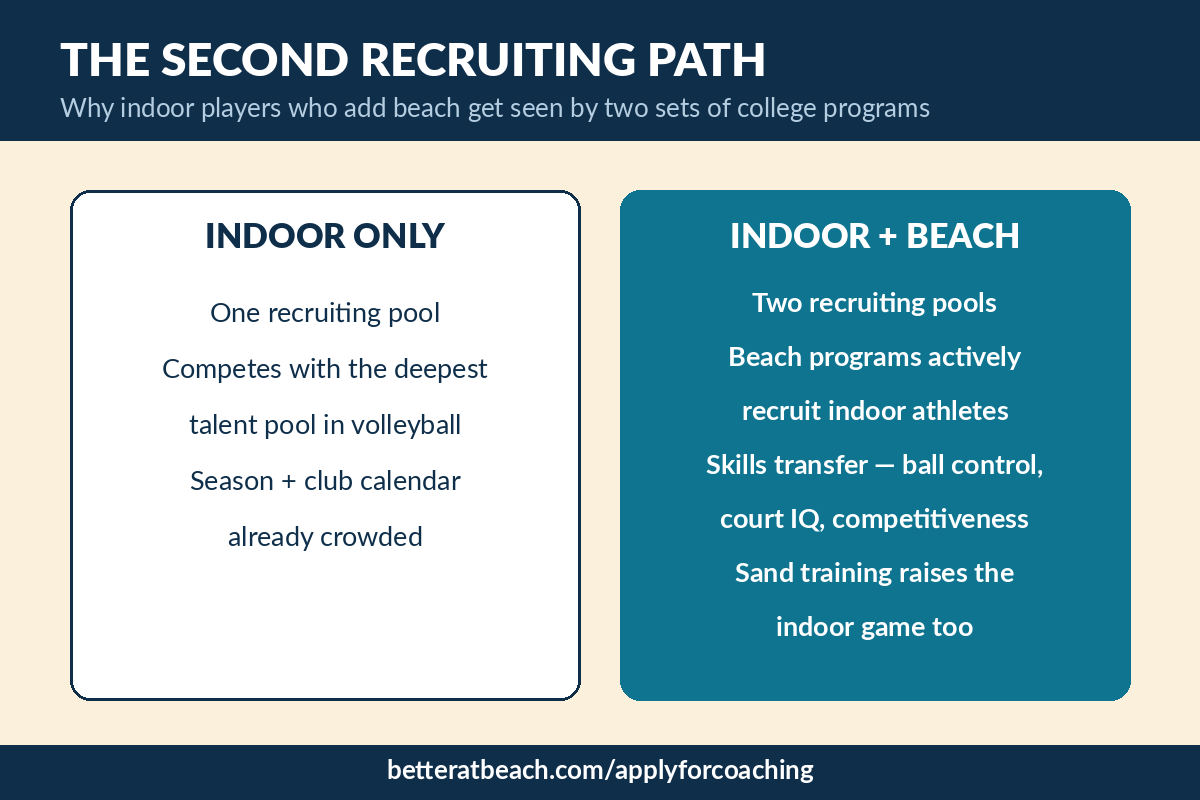
Yes — and they usually don't have to "switch" at all. Most college beach programs actively recruit athletes with strong indoor backgrounds, because ball control, attacking mechanics, and competitive experience transfer directly. The indoor season and the beach season can coexist; what your athlete adds is a second pool of programs that can recruit them.
Why does adding beach open a second recruiting path?
College beach volleyball is still growing faster than its talent pipeline. Rosters need athletes, and coaches know polished sand-specific juniors are rare — so they look hard at indoor players who've proven they can learn the sand game. Scholarship math is moving in families' favor too; we broke down the numbers in our guide to how many beach volleyball scholarships exist in 2026, and the full list of D1 beach volleyball schools shows how many programs are recruiting right now.
To be clear about what I'm not saying: adding beach is not a shortcut, and it isn't free money. It's a genuine second market for a skill set your athlete already mostly has.
What actually changes between indoor and beach?
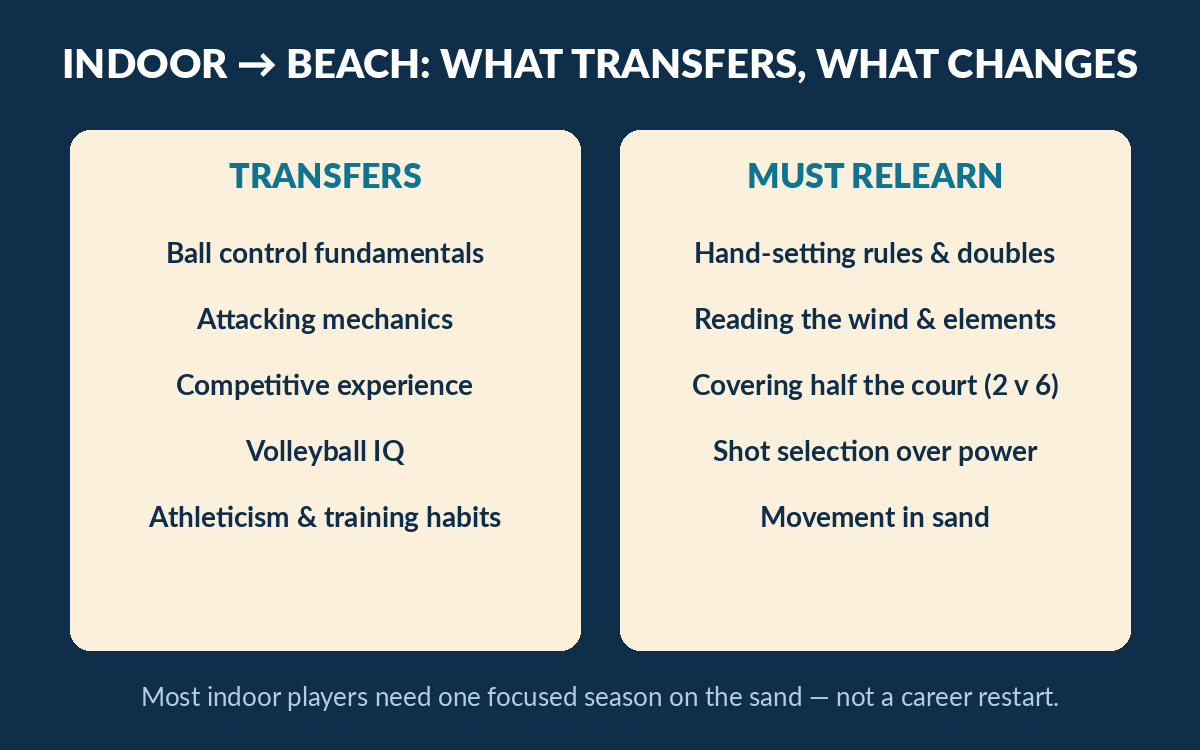
The core skills transfer; the game around them changes. On the sand your athlete covers half the court with one partner instead of one-sixth with five teammates. Hand-setting is whistled far more strictly. Wind, sun, and soft sand punish techniques that worked fine in a gym. Shot selection starts to matter as much as raw power.
Here's the honest rundown of the adjustments I coach indoor players through first:
How long does it take an indoor player to become recruitable on sand?
For most strong indoor juniors, one focused season of real sand training — not just open play — is enough to compete credibly in beach tournaments, and a second season is where recruiting-level results show up. The fastest movers train year-round with structure: skills work, tournament reps, and film review. It is emphatically not a career restart; it's a conversion project.
Two honest caveats. First, the timeline stretches if your athlete only touches sand three months a year. Second, beach results come from tournament placements and film — so the plan has to include actually competing, which is where club beach and tournament costs come into the family budget.
How do college coaches evaluate a crossover athlete?
Coaches watch for three things: whether the athlete moves like they've trained in sand (you can't fake this), whether their partner play — communication, shot selection, siding out under pressure — is real, and whether their trajectory is still climbing. A crossover athlete six months into serious sand training who's visibly improving is often more interesting than a plateaued specialist. That's also why film matters so much on the beach side; results and video do the talking.
What does structured coaching for the transition look like?
You can piece the transition together yourself — local classes, open play, YouTube. Plenty of families do. The failure mode I see is drift: a year passes, the athlete "plays beach" but hasn't fixed the hand-setting, the sand movement, or built any tournament resume.
Our Elite Performance Package is the structured version: 1-on-1 coaching, a personalized training plan built around the indoor-to-beach conversion, video review of your athlete's film, direct communication with their coach, and unlimited access to our camps for 365 days (accommodations not included). It's $3,497 one-time or three payments of $1,200, with a 30-day money-back guarantee. It's application-only — we take intermediate and advanced athletes who can commit about 3 hours a week, because that's who the program actually works for. Here's what the 1-on-1 coaching side looks like in practice:
Is the second path worth it for your family?
Run it like the investment decision it is — the same way we ran the walk-on vs scholarship math. If your athlete loves the sand and is intermediate or better, adding beach roughly doubles the number of programs that can recruit them, builds skills that raise their indoor game, and costs a fraction of what families already spend on club volleyball. If they're lukewarm about it, don't force the second path; coaches can tell.
If you want a coach to assess whether the crossover makes sense for your athlete, apply for 1-on-1 coaching here. It's an application, not a checkout — if we're not the right fit for your athlete's timeline, we'll tell you.