How Many Beach Volleyball Scholarships Are There in 2026? (The New 19-Scholarship Rule)
If you're a parent googling this at 11pm, here's the short answer before the details: the money in college beach volleyball roughly tripled starting with the 2025-26 season, and most families I talk to have no idea it happened.
How many scholarships does a college beach volleyball team have in 2026?
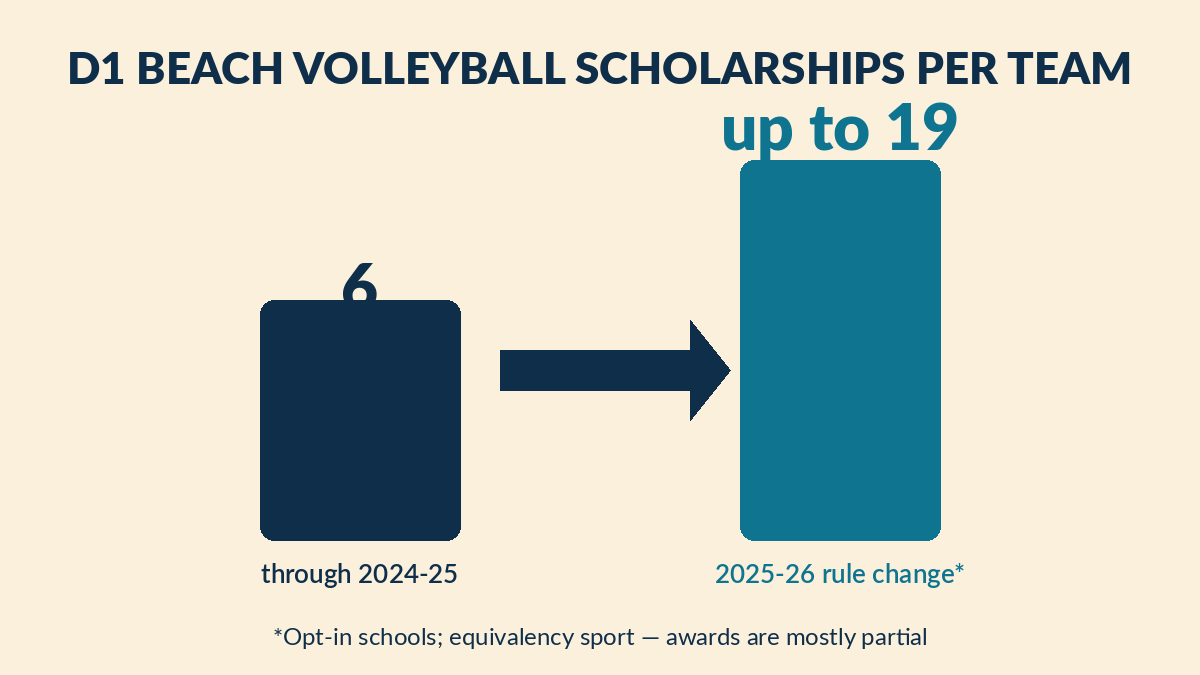
Under the NCAA's recent roster-limit rule changes, Division 1 beach volleyball programs can now offer scholarships to as many as 19 players per team — up from a hard cap of 6. Two important catches: schools have to opt in to the new model, and beach volleyball remains an equivalency sport, which means coaches split their scholarship budget into partial awards rather than handing out full rides. A roster might have one player on 80%, several on half, and a group on books-and-fees money.
So when you see older articles — including some recruiting guides — saying "beach volleyball only has 6 scholarships," that's the pre-2025 world. The ceiling is now three times higher, but the money arrives mostly in slices.
 What does the change actually mean for your daughter?
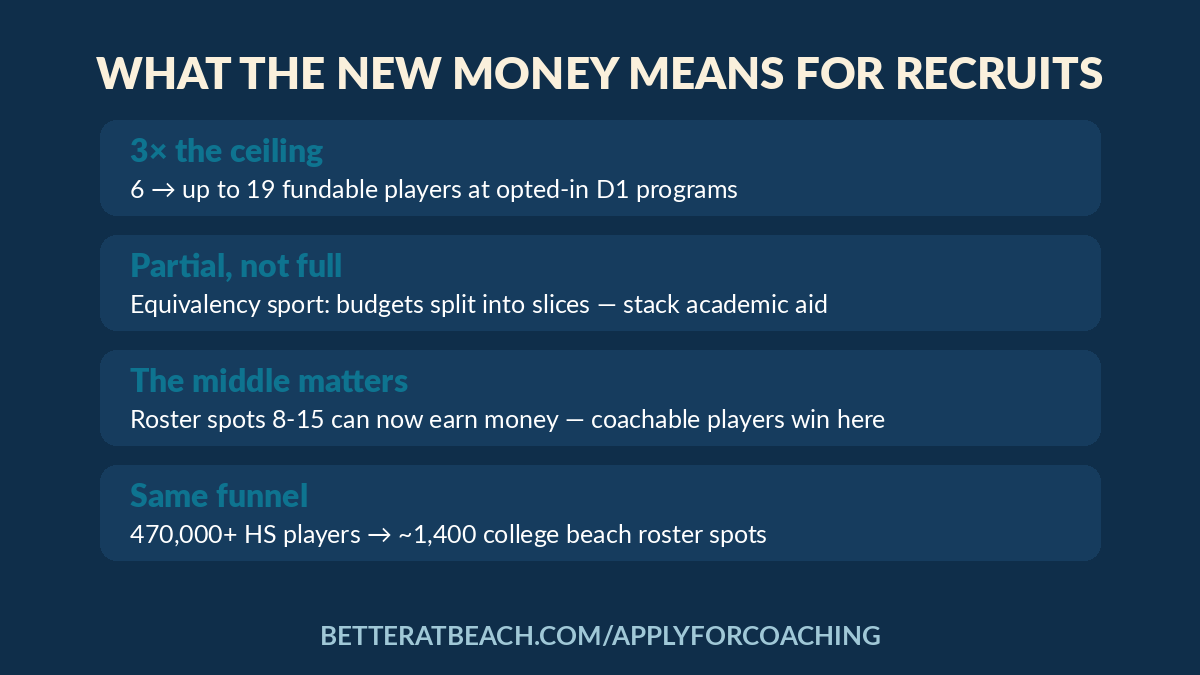
More real opportunities, not more full rides. The realistic goal for most recruits is a meaningful partial scholarship stacked with academic money. (Academic awards often outweigh the athletic slice — my scholarships and financial aid guide covers how families stack them.)
The middle of the roster is suddenly worth money. Under the 6-scholarship cap, money concentrated in the top pairs. With up to 19 fundable spots at opted-in programs, players 8 through 15 on a roster — the "solid, coachable, still developing" tier — can now earn aid. That tier is exactly where good coaching moves the needle most.
The competition math didn't change. Over 470,000 girls play high school volleyball in the US; there are roughly 1,400 college beach roster spots. More money on the table doesn't mean more spots — it means the spots are worth fighting for with better preparation.
 Which colleges give beach volleyball scholarships?
Roughly 90-100 college programs sponsor beach volleyball across NCAA D1/D2/D3, NAIA, and junior colleges — D1 has grown from about 15 programs in 2012 to more than 60 today, still the fastest-growing corner of college volleyball. Remember: D3 schools don't offer athletic scholarships at all (academic aid only), and each opted-in D1 program decides its own scholarship budget. When your daughter builds her target-school list, "sponsors beach volleyball" and "funds beach volleyball generously" are two different lists — ask coaches directly how they structure aid.
If you're starting the process, this walkthrough covers how recruiting actually begins — timelines, contact rules, and where film fits:
How do players actually earn these scholarships?
I'll be blunt, because I'd want someone to be blunt with me: scholarship offers follow preparation that started years earlier. D1 coaches are actively watching sophomores. The players who get funded share three things — technical skills that hold up on film, game IQ that shows in real rallies, and visibility (coaches knew they existed). Talent alone earns nothing if it's invisible, and exposure alone earns nothing if the film shows a swing that needs rebuilding.
That middle tier the new money opened up? It gets won in the training years, not in the recruiting emails. This is a real film session from our coaching program, because this is what "preparation" concretely looks like — a coach going frame by frame through a player's actual game:
Where we fit, honestly
If your athlete is intermediate or advanced — high school, club, or NCAA-bound — and can commit around three hours a week, our Elite Performance Package is built to make her fundable: fully personalized 1-on-1 training, ongoing video review of her film, direct communication with her coach, and unlimited camps for 365 days (accommodations not included). It's $3,497 one-time or three payments of $1,200/month, with a 30-day money-back guarantee. One partial scholarship year can return that several times over — that's the honest ROI math parents should run.
It's application-only and acceptance isn't guaranteed — the model only works when the coach truly knows each athlete's game, so we cap how many we take. If that's the level of preparation your family wants, apply for coaching here.
Earlier in the journey? Start smaller: our online training membership is $1 for 7 days (then $49/month) and includes every skill course plus film review, and our $599 3-day camps — max 10 players per coach — are where a lot of college-bound juniors first train with us.
The bottom line for parents
The scholarship ceiling tripled, the money comes in partial slices at schools that opted in, and the players who collect it will be the ones whose preparation started before junior year. Whether you train with us or anyone else, start now, film everything, and make her impossible to overlook.
See you on the sand,
Mark