Which Beach Volleyball Camp Location Should You Pick? The 2026 Guide
Every week someone asks me some version of the same question: "Mark, I want to do one of your camps — but which location should I pick?" Fair question. We run beach volleyball camps (or sand volleyball camps, depending on which part of the country you learned the game in) in multiple cities every year, and the honest answer is that the "best" location depends on your schedule, your travel appetite, and who's coming with you. After coaching hundreds of campers, here's the exact decision process I walk people through.
How Do You Choose the Right Beach Volleyball Camp Location?
Pick based on three things, in this order: your available time (a long weekend fits a 3-day camp; a full week opens up a training vacation), your travel situation (close to home vs. destination), and the experience you want off the court. The coaching is the same everywhere — same curriculum, same 1:12 coach-to-camper cap (we aim for 1:10) — so you're really choosing a format and a setting, not a quality level.
That last point matters more than people think. Because every Better at Beach camp runs the same system, you can't pick "wrong." You can only pick a trip that fits your life better or worse.
What's the Difference Between a 3-Day Camp and a 7-Day Training Vacation?
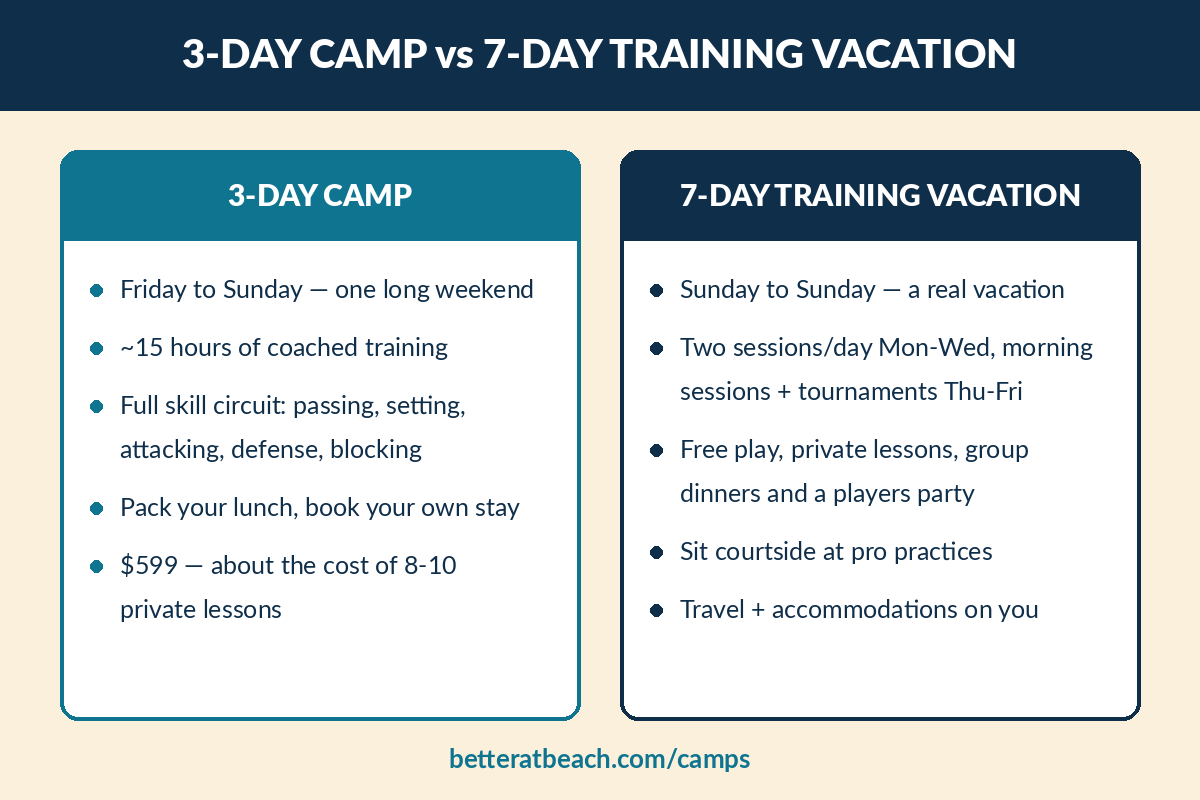
A 3-day camp runs Friday through Sunday and packs roughly 15 hours of coached training into one long weekend — you can fly in Thursday night and be home Sunday night. A 7-day training vacation runs Sunday to Sunday with two training sessions a day early in the week, then tournaments, free play, private lesson opportunities, and a players' party to close it out.
The 3-day format covers the full skill circuit: passing and serve receive on day one, setting and transition, then approach footwork, arm swing mechanics, shot selection, and a full day of defense — digging, reading the hitter, blocking and peeling. It costs $599, which is about what you'd pay for 8-10 private lessons — except you get three straight days of structured team training instead of scattered one-hour sessions.
The 7-day version is the one I call a real volleyball vacation. You train hard Monday through Wednesday, compete Thursday and Friday, and fill the gaps with free play, private lessons, and group dinners. At some locations you'll even sit courtside at pro practices. One thing to know for either format: you handle your own travel and accommodations, and video analysis is available as an optional add-on — it's not baked into the base price.
Should You Pick a Camp Close to Home or a Destination Camp?
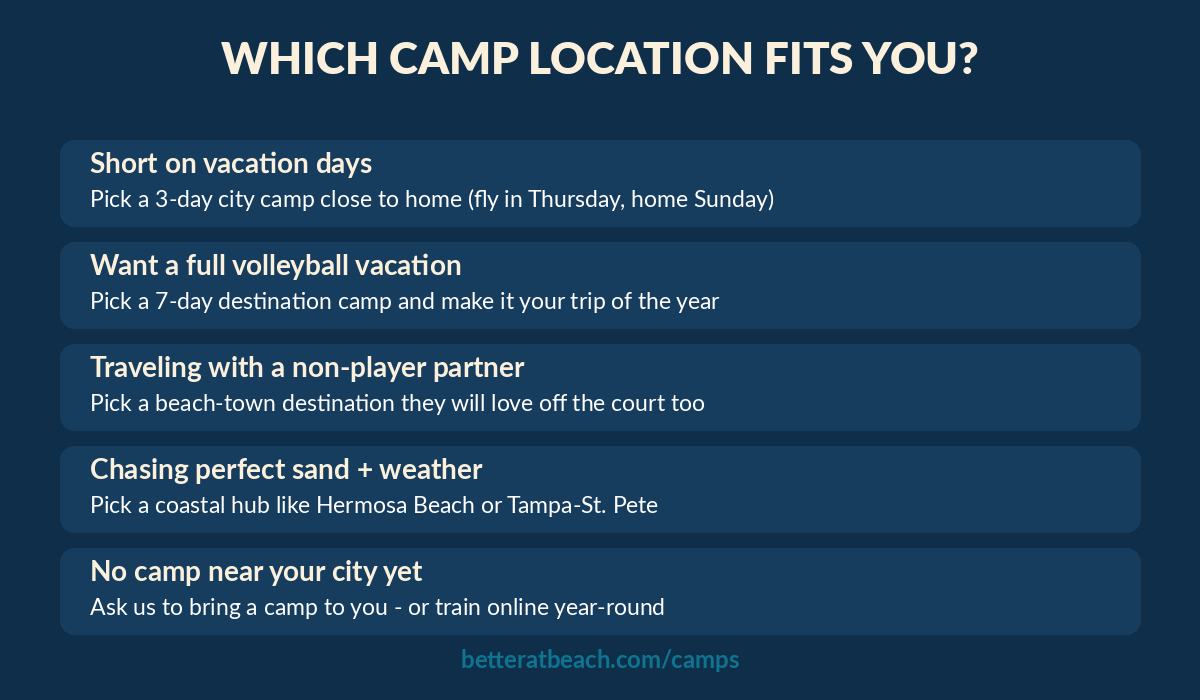
If you're short on vacation days, pick the closest 3-day city camp and treat it like a training weekend. If you can take a real week off — especially if you're traveling with a partner or friends — pick a destination camp and make it your trip of the year. The travel-plus-training combination is honestly my favorite way to experience this sport.
I've built a lot of my own life around exactly that combination — here's what it looked like when I flew to Barcelona just to play with strangers on new sand:
And if your partner doesn't play (yet), a beach destination gives them a real vacation while you train. Marine and I filmed a whole vacation training routine in Greece for exactly this situation:
Which Cities Have Better at Beach Camps in 2026?
Our two home hubs are Hermosa Beach in Los Angeles and Tampa-St. Petersburg in Florida — both with deep, well-groomed sand, reliable weather, and a real beach volleyball culture around them. Beyond those, our 2026 calendar is the biggest we've ever run, with more camps coming in cities like San Diego, Long Island, Austin, St. Pete, Asheville, Virginia Beach, and White Sands. The camps page always has the current list with dates and registration deadlines — several 2026 camps have registration windows closing over the next few months, so if a city and date fit, don't sit on it.
Does the Coaching Change From Location to Location?
No — the curriculum, the coach-to-camper ratio, and the level grouping are identical at every camp. We cap every camp at a maximum of 1 coach per 10 campers, and we split training groups by level, so a Hermosa camp and an Austin camp run the same system on different sand. What changes is everything around the training: the town, the water, the restaurants, the vibe of the group that particular weekend.
So if you're agonizing over which city has "the best coaching," stop — that variable is fixed. Spend your decision energy on dates and destination instead.
What If There's No Camp Near Your City?
Two options. First, we take requests: if you can rally a group, we will literally bring a camp to you — there's a "book a camp near you" option on the camps page. Second, remember that a camp is three to seven days of your year. The other 360 days are where most of your improvement actually happens, and that's what our online training membership is for — complete skill courses, live Q&As with our coaches, and structured practice plans you can run at any public court, even if you're landlocked.
How Do You Get the Most Out of Whichever Camp You Pick?
Show up already working on the fundamentals, then use the camp to pressure-test them — that's the pattern I see in every camper who makes a huge jump. The players who improve fastest treat camp as the intensive in the middle of a training plan, not the whole plan. Coaching before camp, coached reps at camp, coaching after camp.
That's why my standard recommendation is the combination: join the membership, train for a few weeks, then book your camp. The $1 seven-day trial gets you into everything — all our courses, the live Q&As, video analysis — so you can start preparing today and walk onto the sand at camp ahead of the curve.
Ready to pick your city? Browse every 2026 camp location, date, and registration deadline at betteratbeach.com/camps — and if you want to arrive in the best shape of your volleyball life, start your $1 membership trial today.