
No Beach Volleyball Coach in Your Town? Here's How Landlocked Players Train
I get this email at least once a week: "Mark, I love beach volleyball, but I live in Ohio / Denver / Toronto and there's no coach within three hours of me. Am I stuck?" You're not stuck. Some of the fastest-improving players in our program train in landlocked cities — beach volleyball (or sand volleyball, as most of the middle of the country calls it) is one of the most trainable sports on earth once you know what to work on and how to get feedback without a local coach.
Can you get real beach volleyball training without a local coach?
Yes. You need three things: structured practice (knowing exactly what to work on each week), honest feedback on your technique, and periodic live reps against good competition. The first two don't require a coach in your zip code — they require a plan and a camera. The third you can schedule a few times a year.
That's not a consolation prize, either. Plenty of players who live two blocks from a beach spend years plateauing because they only ever "play." A landlocked player with a plan and a feedback loop routinely passes them.
What should landlocked players train first?
Train the things that transfer from anywhere: serving accuracy, platform control, your arm swing, and your athleticism. You can do targeted serving practice on any grass field or indoor sand facility. Wall and partner passing reps build ball control in a garage. Strength and vertical work happens in a normal gym.
My complete skill courses — serving, passing, arm swing mechanics, defense — are inside our membership, so one $1 trial gets you all of them for 7 days. Here's a taste of the kind of pre-season strength work you can do with zero sand in sight:
How do you practice with no beach court in your town?
Get creative with surfaces and formats. Grass doubles is the classic landlocked substitute — the ball control and small-court reading skills transfer almost completely. Indoor sand facilities are spreading fast across the US and Canada; search "sand volleyball courts near me" and you may be surprised what's within an hour. Even indoor 2v2 on a badminton-width court forces the communication and shot selection that beach demands.
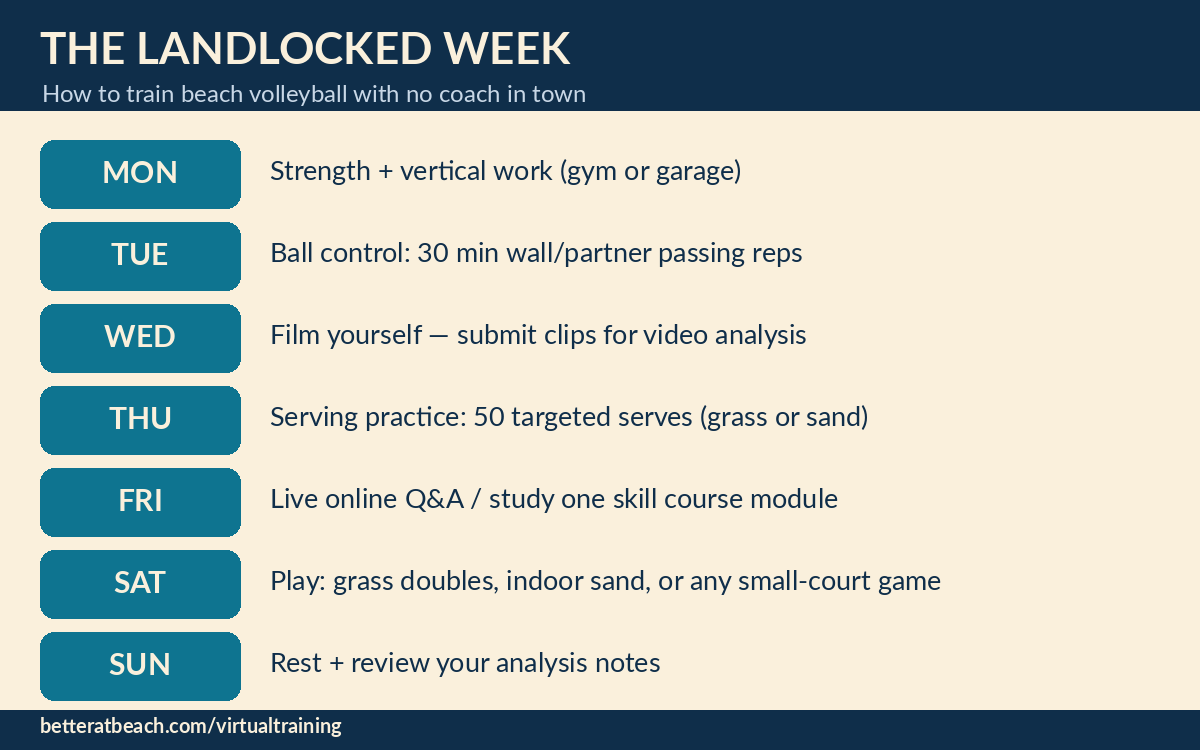
A simple weekly split beats random play every time:
What can't you train without sand — and does it matter?
Let's be honest about the gaps, because pretending they don't exist is how you get surprised at your first tournament. Sand movement — the low, patient footwork and the timing of jumping out of soft sand — is the one skill you can't fully replicate on grass or in a gym. Deep-sand conditioning is its own animal, and your first twenty minutes on real sand after months away will humble your calves.
Here's the thing, though: sand movement is also the fastest skill to re-acquire. In my experience coaching campers who arrive from landlocked cities, the players with clean technique and a strong vertical adapt to the sand in a day or two. The players who spent that same year only free-playing on sand but never fixed their arm swing? Their problems come to camp with them. Technique travels; sand legs come back quickly. So spend your landlocked months on the things that are slow to build — mechanics, ball control, strength — and let the sand-specific adaptation happen in concentrated doses when you travel.
One more gap worth naming: live reads against real opponents. You can partially cover this with grass doubles and any 2v2 format, but you should also study the game deliberately — watching film of your own matches (even grass matches) with a coach's commentary teaches court reading faster than another hundred unexamined games.
How does online beach volleyball coaching actually work?
Our membership is built exactly for this player. You follow structured programs, you film your reps on your phone, and you get video analysis and live Q&A sessions with our coaches — so you have professional eyes on your technique every single week, no matter where you live. It's a $1 trial for 7 days, then $49/month or $497/year if you stay.
This is what a video analysis session looks like — this is the feedback loop that replaces a local coach:
And here's a live member meeting, where players from everywhere — including plenty of landlocked cities — bring their questions and their film:
When should a landlocked player go to a camp?
Once or twice a year, as a capstone. A 3-day camp is $599 — about what 8–10 private lessons would cost — with a written 1:12 coach-to-camper cap (we aim for 1:10), and video analysis available as an optional add-on. Camps are really multi-day lessons: you get more coached touches in three days than most landlocked players get in a year, and then you take that home to your weekly plan.
The combination is the whole system: train online all year, then use a camp to compress months of correction into a long weekend. Our best-improving members do exactly that — and because they show up with months of video analysis behind them, their camp coaches aren't starting from zero. We already know their game before they step on the sand.
If you're choosing between spending your budget on scattered local lessons (whenever you can find someone) versus a year of structured online coaching plus one camp, I've watched both paths play out many times. The second one wins, and it usually costs less.
Start training this week
You don't need a coach in your town. You need a plan, a phone camera, and coaches who will actually watch your film. Start the $1 trial — you get 7 days of the full membership: every skill course, live Q&As, and video analysis. If it's not for you, cancel in one click. If it is, you'll never feel landlocked again — because the coach you couldn't find in your town has been available on your phone the whole time.