
How to Play Beach Volleyball: The Complete Beginner's Path
Every summer I watch someone walk onto the sand for the first time, shank three passes in a row, and fall in love with this sport anyway. Beach volleyball — or sand volleyball, as it's called across much of the country — is the most fun you can have while getting humbled by a ball and a breeze. I've coached thousands of players from their very first serve to competitive tournaments, and the path from "never played" to "competent beach player" is far more predictable than most beginners think. Here's the complete path I give every new player.
What Are the Basic Rules of Beach Volleyball?
Beach volleyball is played 2-on-2 on a sand court measuring 8 by 8 meters per side, and your team gets up to three touches to send the ball over the net. Sets are played to 21 points (rally scoring, win by two), matches are best two out of three sets, and the third set goes to 15.
A few rules surprise players coming from indoor or casual grass games: a block counts as one of your three touches, open-hand tips are illegal, and teams switch sides every 7 points because sun and wind are a real part of the game. There are no rotations and no substitutions — it's you and your partner covering the whole court, every rally. That's exactly what makes the doubles game the fastest way to improve at any volleyball skill: you can't hide.
What Skills Should a Beginner Learn First?
Learn in this order: passing, serving, setting, then attacking. Passing and serving come first because every single rally starts with one team serving and the other passing — if you can do both at a basic level, you can play a real game on day one.
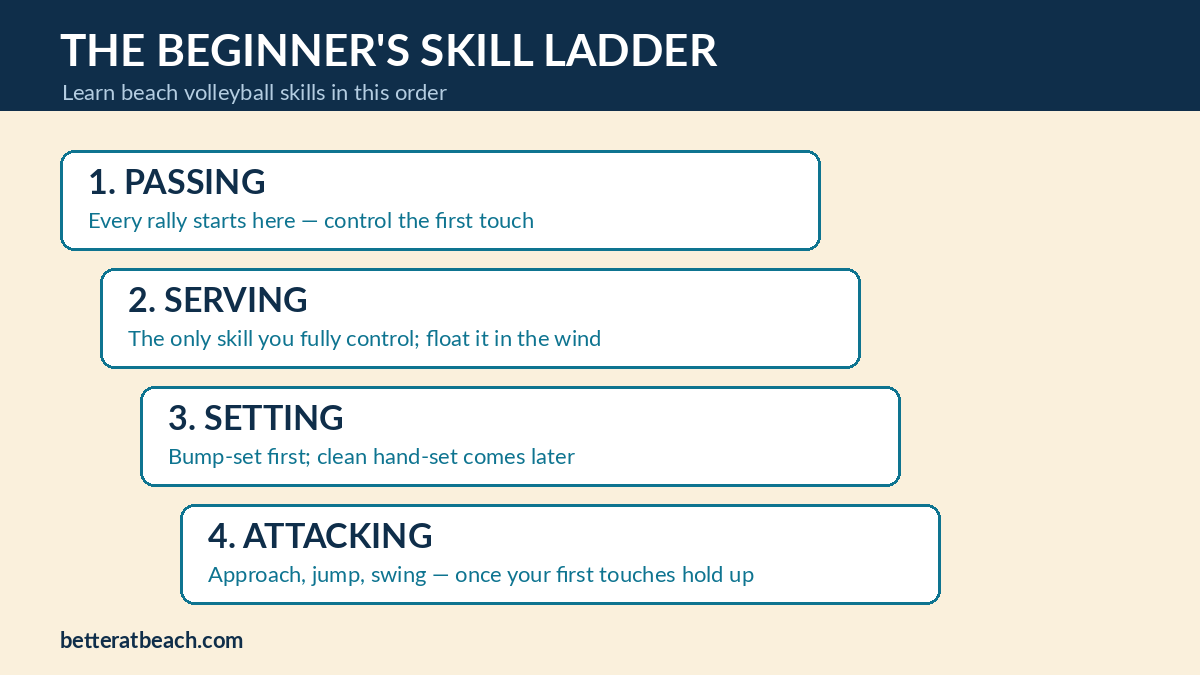
Here's why this order matters. In doubles, if you pass poorly, you're also the person who has to hit next, so a bad pass punishes you twice. Serving is the only skill you control completely — no partner, no opponent, just you and the ball. Setting and attacking take longer to develop, and in the beach game you'll usually bump-set for your first several months anyway, which is legal and reliable in the wind.
Start with passing. This video covers the three things I fix first with every new player:
How Do You Serve in Beach Volleyball?
Start with a standing float serve: toss low and in front of your hitting shoulder, contact the middle of the ball with a firm, flat hand, and finish toward your target. A float serve has no spin, so it wobbles in the wind — which makes it far more effective on sand than it ever was indoors.
Most beginners can develop a consistent overhand float serve in two to three focused sessions. Here's my full beginner progression:
Is Beach Volleyball Harder Than Indoor Volleyball?
The skills are the same, but the sand, the wind, and covering half a court with only two players make beach volleyball more physically demanding per rally. Moving in sand costs roughly twice the energy of moving on a hard floor, and there's no libero coming in to pass for you.
The upside: sand is forgiving on your joints, and because you touch the ball on almost every rally, you improve faster than you would standing in an indoor rotation waiting for your turn. Players who train on sand consistently tell me the indoor game feels like it's happening in slow motion afterward.
Where Can You Play Sand Volleyball as a Beginner?
Search for public sand volleyball courts in your city, then look for beginner leagues and open play nights — most metro areas have both, and coastal or sunbelt cities have thriving year-round scenes. Bars and rec centers with sand courts often run "BB" or novice divisions where nobody expects you to be good yet.
If you're landlocked or can't find courts, you have more options than you think — grass doubles leagues teach the same 2-on-2 game, and structured online coaching lets you train the skills at home between sessions. The important thing is reps against a live server, so find any regular game you can and show up weekly.
How Long Does It Take to Get Good at Beach Volleyball?
With one or two playing sessions a week plus deliberate skill practice, most athletic beginners can hold their own in a novice tournament within about three months. Getting to a solid intermediate level — clean passing, a reliable serve, a real approach and swing — typically takes a season or two of consistent play.
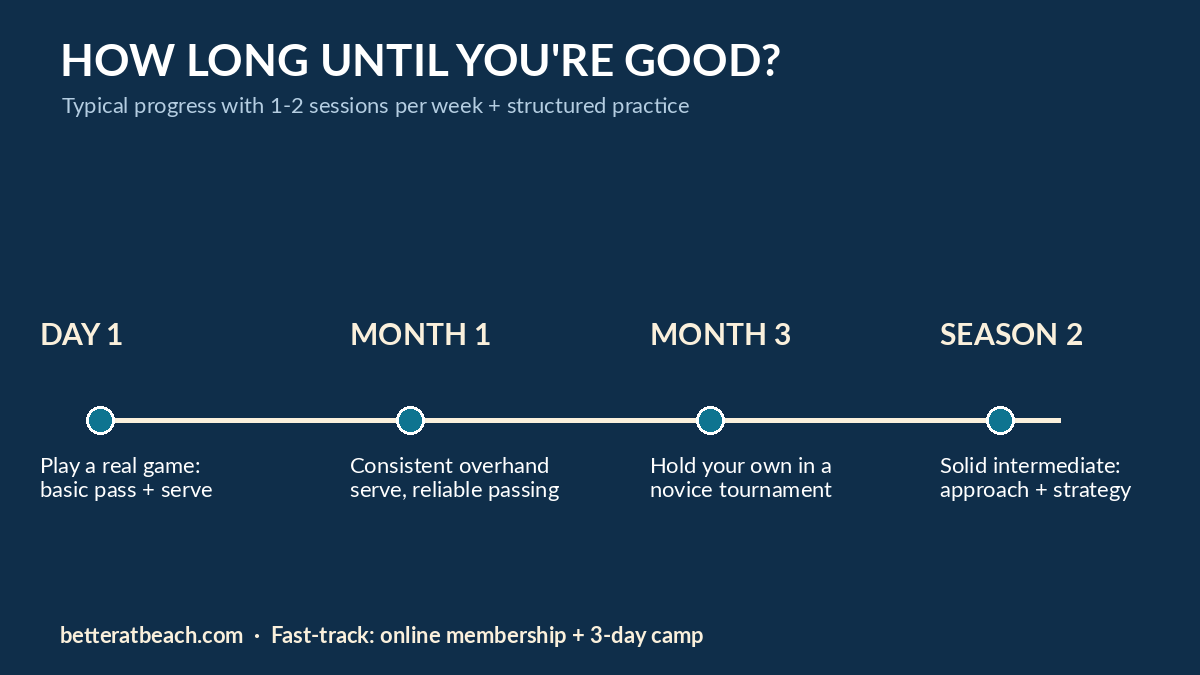
The single biggest variable isn't athleticism. It's whether you're practicing the right things in the right order or just repeating your mistakes in open play. That's the difference coaching makes.
What's the Fastest Way to Learn Beach Volleyball?
The fastest path is structured coaching: learn the correct technique before bad habits set in, then get reps with feedback. That can mean local beach volleyball lessons or classes, a multi-day camp, or online training you follow between games.
Here's how I'd structure it if you're starting from zero. Begin with my online membership — my complete beginner courses for serving, passing, setting, and attacking are all inside it, and a $1 trial gets you all of it for 7 days. Follow the progressions, play weekly, and when you're ready to level up fast, come train with us in person. Our beach volleyball camps are essentially three days of intensive lessons — small groups capped at a 1-to-10 athlete-to-coach ratio, $599 for the weekend, with video analysis available as an optional add-on. The players who improve fastest combine both: online training before and after, camp in the middle. Here's what a camp actually looks like:
Ready to start? Grab the $1 seven-day trial of the Better at Beach membership — every beginner course, practice plans, and live coaching, and you can cancel in one click if it's not for you. After the trial it's $49/month or $497/year. See you on the sand.