College Beach Volleyball Camps 2026: UCLA, USC, FSU — and When to Attend Ours First
If your daughter is serious about college beach volleyball, somebody has probably already told you to "get her to the UCLA camp." I'm a professional beach volleyball player and coach, and I've spent years helping junior athletes — beach and sand volleyball players alike — get ready for exactly these events. So let me give you the honest version of what college camps are, which ones people are searching for in 2026, and the mistake I watch parents make with them every single summer.
What are college beach volleyball camps really for?
College camps — often called ID camps or prospect camps — are evaluation events, not development events. That's the single most important sentence in this article. The school's coaching staff runs the sessions, and yes, your athlete will get some instruction. But the real product is visibility: the coaches are watching to see who can already play. Nobody's arm swing gets rebuilt in a weekend on a college campus. Coaches leave with a short list, and your athlete is either on it or not based on the skills she walked in with.
That's not a criticism — it's just what the events are. The problem is parents who treat an ID camp like training. You don't send an athlete to an evaluation to learn. You send her there to be seen at her best.
Which colleges run beach volleyball camps in 2026?
Most of the powerhouse programs run summer camps or clinics: UCLA, USC, TCU, Florida State, LMU, and a long list of other D1 beach programs. Dates, ages, and prices change every year and vary a lot from school to school, so always check the athletics camp page of the specific school — and know that under NCAA rules these camps are generally open to any athlete who pays, not just recruits. That's worth repeating: attending a school's camp is not an offer, a tryout invitation, or a relationship. Sometimes it becomes the start of one. Usually it's a data point the staff files away.
A good rule: pick college camps at schools that realistically fit your athlete's level and grades, not just the biggest brand name. A coach who could actually recruit her is worth ten who never will.
When should your athlete attend a college camp?
When she can compete there, not before. D1 coaches are actively evaluating players as early as their sophomore year, so the window is real — but showing up unprepared to be evaluated is worse than waiting a year. The math is brutal and you should hear it straight: roughly 470,000 girls play high school volleyball in the US, and there are only around 1,400 college beach volleyball roster spots. The encouraging flip side is that the sport is growing fast and the scholarship money jumped dramatically — D1 programs went from 6 scholarship equivalents to roughly 19 with the 2025-26 roster rule changes. More money on the table, but the evaluation standard hasn't gotten softer.
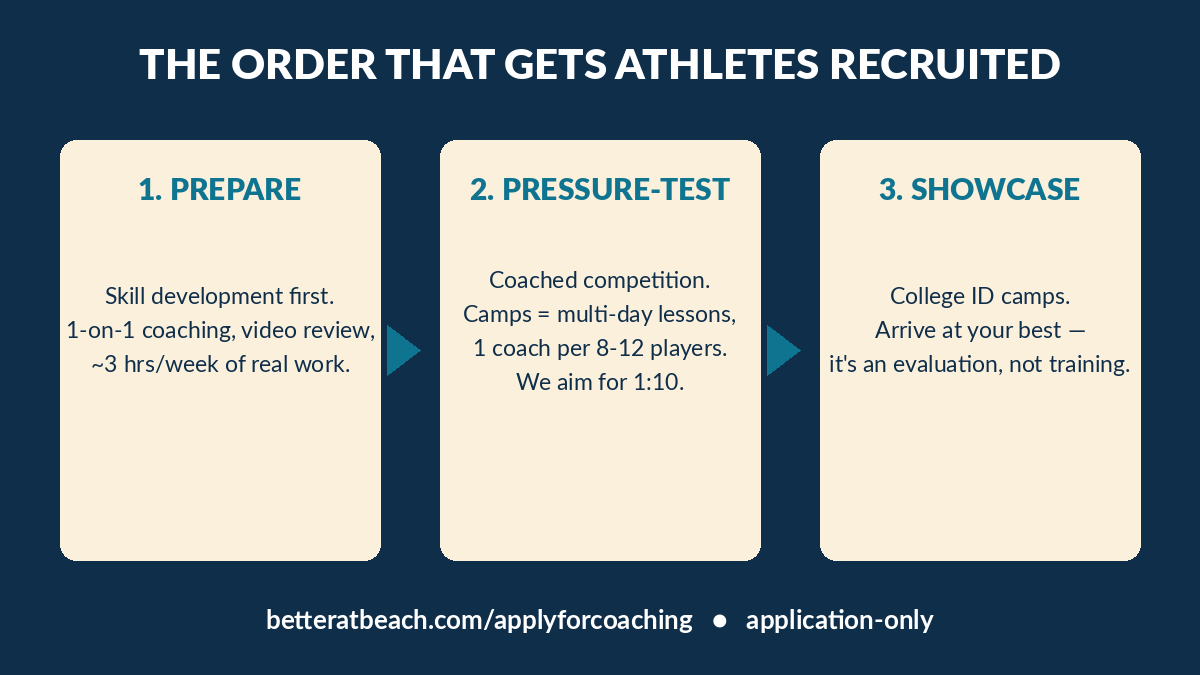
Here's how the recruiting process fits together, from the beginning:
Should your athlete train before an ID camp?
Yes — and this is the part almost everyone gets backwards. Families will spend on the college camp, the flights, and the hotel, and then send an athlete whose passing platform hasn't been coached in six months. The evaluation happens in the first hour of day one. If she's rusty, that's the version of her the college staff remembers.
The sequence that works: build skills first with consistent coaching, use our camps and coached reps to pressure-test them, and treat the college ID camp as the showcase at the end of the chain. Camps are multi-day lessons, and our beach volleyball camps ($599, coach-to-player ratio capped at 1:12 (we aim for 1:10)) put juniors through more coached contacts in three days than most club players get in a month.
How do I prepare an athlete for college camps one-on-one?
For families who want the full pathway handled, I work with a small number of junior athletes directly. My Elite Performance Package is 1-on-1 coaching: fully personalized training, video review of her actual film, direct communication with me, plus unlimited access to our camps for 365 days (accommodations not included). It's $3,497 one-time or three payments of $1,200/month, it comes with a 30-day money-back guarantee, and it's built for intermediate-to-advanced athletes on the HS/club/NCAA track who can put in about three hours a week.
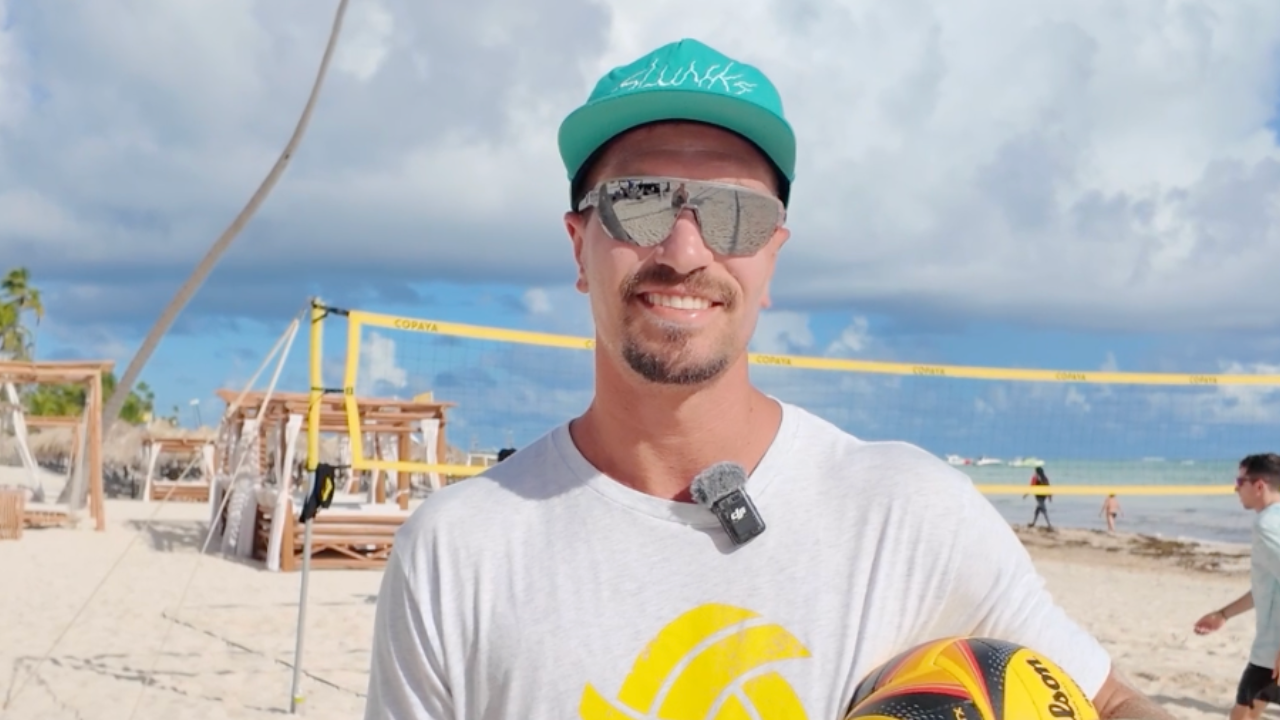
This is what the coaching actually looks like — a real member film session, not a highlight reel:
It's application-only and I don't accept every athlete — the program only works if the fit is right, so I'd rather say no than take your money. If your athlete is targeting college camps in the next year or two, apply for 1-on-1 coaching here and tell me where she is now and where she's trying to go.
What's the bottom line for parents?
College beach volleyball camps are worth attending — at the right schools, at the right time, with an athlete who's ready to be evaluated. They are marketing and evaluation events, so do the development work first. If you want a lower-commitment starting point while you plan, our online training membership is $1 for a 7-day trial, and every course I've made — serving, passing, defense, all of it — is inside. Prepare first. Showcase second. That order is the whole game.