
The Ultimate Guide to Setting in Beach Volleyball: Hand Setting, Bump Setting & the Perfect Set
Beach volleyball — or sand volleyball, as the game is called across much of the country — is won and lost on the second contact. This guide covers every part of setting: hand setting, bump setting, footwork, set location, wind strategy, mechanics, drills and the most common mistakes.
Setting in Beach Volleyball
Bump setting in beach volleyball is one of the most essential techniques you can master. It’s a relatively simple skill to conquer, that you need to have in your bag of tricks at all times. This guide will provide everything you need to know about setting in beach volleyball. We’ll take you through some important key points for setting in beach volleyball, show you how to practice setting effectively and give you examples of how to master setting so you can start taking those Wins!
Let’s get started by watching as Brandon shows us how to bump set while at one of our volleyball vacation camps in St Pete Beach, Florida.
Key Points to Remember:
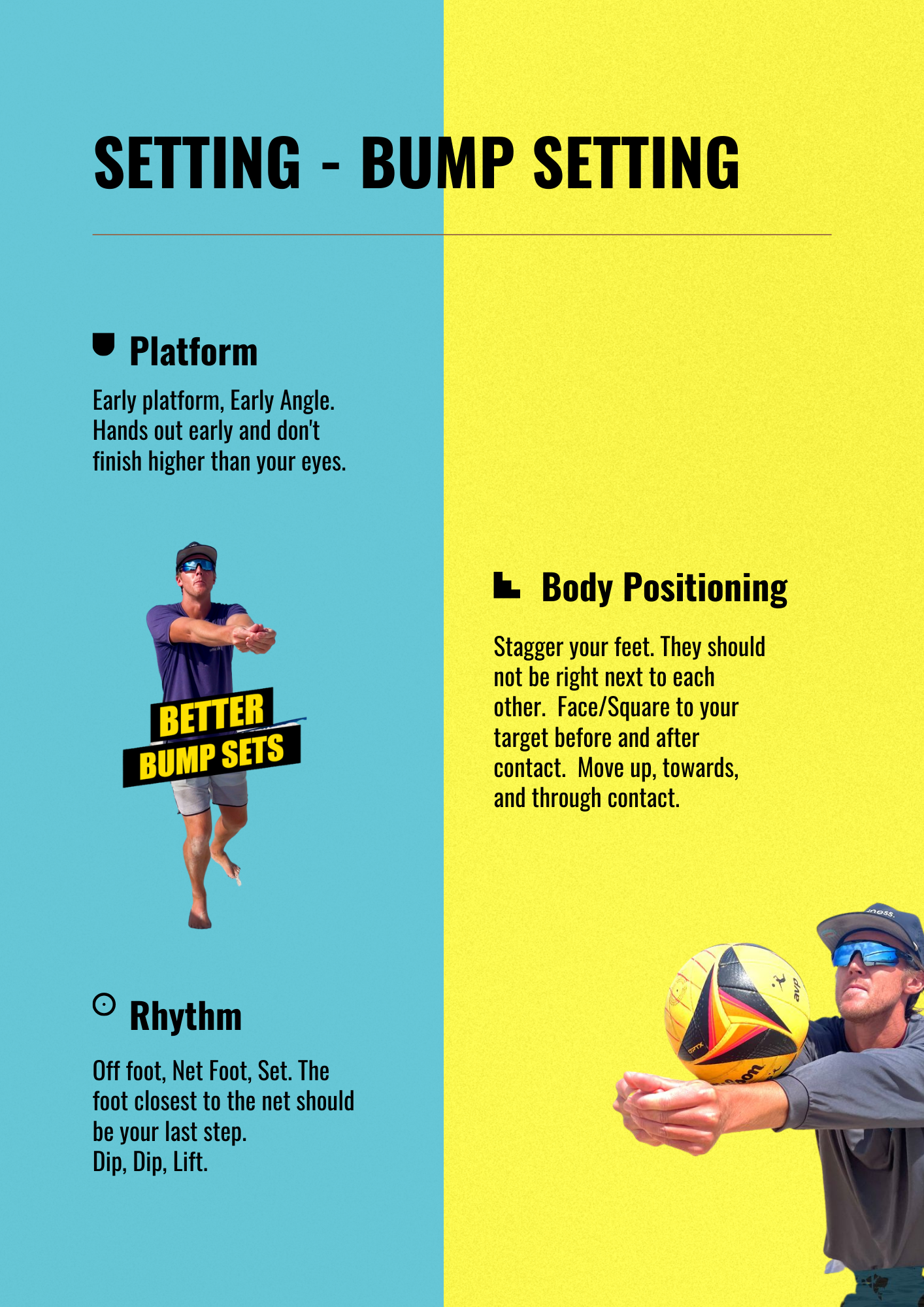
1. Platform straight and hands together - This is a technique that should be the exact same as passing in beach volleyball. It is important that you hold your hand tight and keep your arms straight throughout the entire process of the set, just as you would the pass.
2. Net foot forward - When approaching the ball to set, you should think about getting your net foot forward. The reason we say ‘net foot’ is because throughout a play you may have your left foot or right foot forward depending on what side of the court you are on. There are two reasons why this is going to be important. First, it will allow you to develop a rhythm to your set because you will be moving from your back foot to your front foot, allowing your energy to end up on your front foot during contact. This rhythm will allow your set to be something you can replicate while also allowing your hitter to pick up on your rhythm which will make the set easier for them to get to. Second, it will allow you to accomplish beach volleyball setting key No. 3.
3. Square to Target - Unlike passing, where your shoulders should be square to the net, setting is going to be easiest when you are square to your target. You should always try to finish a set with your belly button facing your attacker. If you are able to be square while setting then you have made the skill as easy as you can relying on a straight pass/set.
What is a set in beach volleyball?
The set is going to be the second touch in a rally. Most of the time, whenever I'm coaching somebody, it looks like they think that their job is just to touch the ball second and then their partner should touch the ball third. That is not the case. Whenever you step on the volleyball court, you need to think of yourself as being a setter, not a second ball "toucher".
What that means is that you need to put thought into each touch that you are making. This goes for passing, setting or attacking. Right now with this course, we're going to be focusing on setting so whenever that ball gets served across the net and your partner passes the ball as you are approaching to make your set, there are a couple things that you should be thinking about.
One: Where should your body be before you were actually going to make this set?
Two: What type of set is your attacker looking for?
Three: What should your finish look like before your attacker actually performs the skill of attacking whenever you are, not the one receiving a serve. Make sure that you get into a mindset quickly of being a setter and have a purpose with that touch, rather than just running around and making sure that you've touched that second ball. Let's put up a good hittable set.

Beginner Hand Set
When working on hand setting, you are going to go through our basic footwork drill, whereas you’ll have a self-toss, off foot-net foot-set. If the net is on my left side, then my left step is my last forward step. It's going to be a self-toss -- a small six-inch toss, with the footwork being right, left, stand, and set. We want long contacts. We want to have the ball long but always going up, so allow your hands to melt and relax.
We're going to be setting a normal hand set, often in front of us, and then one hand set slightly behind us. If the wind carries this ball behind us, then there’s a large chance we will double or lift. It is important to stay behind the ball and then rock forward.
Now without a ball, try to do the rocker step backwards, then forward. You can also do it sideways then forward. That little rocker step is going to allow you to make those late adjustments, but again it's always two steps ending; off foot - net foot.
What Is the Correct Footwork for Setting in Beach Volleyball?
Off foot first, then net foot — dip, dip, and lift. Keeping the net foot forward stops your momentum from carrying the ball over the net, which is what turns a good pass into a free ball for the other team. Run the same two-step routine every single time and setting becomes a rhythm you repeat instead of a scramble you survive.
This next piece of footwork is our setting footwork. It's off foot, net foot, set, or what we like to call a dip, dip and lift. The important part to remember for this piece of footwork is that when we're setting, we'd like to have our net foot forward. The theory is that this prevents us from over setting since our natural square is going to be just a little bit off the net, but it also gives us the same routine to do before every set, and if we have the same routine or same process, we get more accurate over time.
Similar to an NBA player who's shooting a foul shot, they're going to have the same routine. We can do that in the midst of a point so that we have a rhythm and an established routine to perform that skill.
My off foot goes first, then my net foot. I'm dipped in this low position, and then I extend - so it's dip, dip and lift. If I'm setting from the opposite side, it's going to be the opposite foot work. We’ll show you a few clips of this in action at the end of this video so you can see the footwork that all the pros use.
AVP pros Brandon Joyner and Mark Burik in this training video demonstrate proper beach volleyball setting technique when dealing with the wind on either side of the net.
Ramp up your game. Try one of our Exclusive 7-day Training Camps in St Pete Beach!
Every 7 Day Beach Volleyball Camp Includes:
18+ Hours of Instruction and Training.
Professional coaches and players lead your training.
Introductions to current professional beach volleyball players.
Sit court-side at AVP and FIVB World Tour practices!
Chance to enter local tournaments when available.
Local knowledge, outings, and more!

How Do You Set in the Wind in Beach Volleyball?
Read the wind before the serve and set with it, not against it. Into a headwind you have to push the ball further and flatter because the wind pushes it back at you; with a tailwind you set shorter and let the wind carry it to your hitter. Players who treat wind as information rather than punishment cut their setting errors dramatically — and on most sand volleyball courts in this country, wind is the norm, not the exception.
One of the easiest ways for you to get in trouble as a setter is not knowing how to deal with different types of winds. Obviously, winds can come from all different directions, whether it's a headwind, which means that it will come at you almost like it's coming at the net or going the other direction towards the net on your side. It can also be a cross court wind, where you are setting into the wind, or it can be a cross-court wind where you're setting with the wind.
You need to understand that if you start thinking about the wind as being a punishment, then setting is always going to be very difficult. But if you start to think about the wind as being something that you're going to use to make a great set, then it's going to be something that'll be a little bit easier for you to think about.
I am currently standing on the South side of the beach volleyball court. The other side of the net is the North side of the court. If we're dealing with a wind that is coming from the North to the South, then that means that every time that I'm setting, I'm going to have to be pushing the ball into the wind. This is important to realize because it's almost going to feel like I'm over setting every single ball that I'm dealing with, but I need to realize that that wind is going to push this ball back. So I know that the game of volleyball is very difficult already, but we need to start thinking about this wind with every single touch that we make, and it has to be a split second decision, right?
As you are going to make this touch, you need to realize where is this wind coming from. Right now it's going North to South so I need to push this ball a little bit tighter to the net because the wind is going to push it off. If we think about the wind coming from the South and going towards the North, then that means that the wind is going to be helping me. If I'm pushing the ball with the wind, then that means that I need to aim about five feet off the net because the wind is going to bring this ball closer to the net for my attacker.
So as I'm going, I'm going to make sure that I lift this ball and I'm thinking about aiming five feet off the net, knowing that that wind is going to push that ball closer to the net.
How Do You Set in a Cross-Wind in Beach Volleyball?
Put topspin on the ball. Topspin cuts through a cross-wind and holds its line, while a spinless, floating set gets shoved sideways past the antenna. Roll the ball off your fingers in the direction you are pushing it and start the set slightly upwind of your hitter’s shoulder so the wind delivers it to the right spot.
Another type of wind that you are probably going to have to deal with is a cross-wind. Here, it is really important to try to find a way to put top spin on this ball because if you put topspin on this ball, then that ball is going to cut through that wind and it's not going to hang up there and get blown back.
So if you are pushing the ball into the wind, we want to think about rolling this ball off of our hands, allowing it to cut through because the distance between you and your attacker still has to remain the same. We can't use 'the wind pushed it inside' as an excuse.
Now that we've switched sides, and now the wind is still coming from the West to the East, because that's the one that we deal with in California. I need to think about now the wind is going to help me make this set. Normally, I would set this right side attacker where they are five feet from the sidelines, then I need to lift this ball in the air. We do not want spin on this ball because we want the ball to be taken by the wind and if we have spin on it, then it's still going to be cutting through that wind.
Whenever you're setting with the wind, you want to think about lifting this ball and allowing the wind to do the job for you. So if I'm trying to get this ball to land five feet from the sideline, then I'm going to lift my set to aim to where the set maybe is going to land eight to 10 feet from the sideline, knowing that this wind is going to push that ball closer to the side. Whatever wind you are dealing with, you need to realize, is the wind fighting against me as a setter or is it helping me as a setter?
Those are two of the types of winds that you are most likely going to be dealing with, and as long as you understand what type of wind you're dealing with, when you are making that touch, then you're going to be able to put yourself into the position to make the best set possible.
Get a free drill book and check out our other beach volleyball video courses!
How tight should we set in beach volleyball?
We run into this topic a lot during our classes and it's about how tight we should set the ball. How far are the best beach volleyball players in the world are off the net when they're hitting?
Shorter players usually say that they need the ball tighter in order to be effective. The problem with this mentality is that if you ask somebody to set you one, maybe two feet off the net, there is going to be a range of errors and we will know all about it on this video clip analysis by Mark Burik.
Our recommendation is to make sure that you stop asking for tight sets. Make sure you keep yourself away from the net so you will get blocked less, and you will get more kills. That is your quick little lesson on how far should we set from the net.
We offer video coaching services. You can send us your footage and we can coach and can critique your game based on your video. One of our professional player coaches will sit down with you and talk to you via a Skype or FaceTime session and go through your footage play-by-play so that they can help you. We also have classes almost every day in Hermosa Beach and we have a lot of camps coming up next year so if you're interested in a seven day training camp in California, please do visit us, you're more than welcome.
Why Should You Speed Up to Slow Down When Setting?
Move early and fast so that your last movement before contact can be slow. Getting to the ball late forces a rushed, hard contact, and that is where most ball-handling errors on sand come from. Sprint to the spot, then exhale and make a long, calm contact — your hitter gets a set they can read every time.
There will be a lot of situations in Beach Volleyball where you have to rush in order to slow down. We'd like to be in places or position ourselves very early so that we can make calmer and softer plays later.
A lot of this happens in defense. We want to rush back to our spot, but sometimes in the midst of just setting, we're going to have to rush somewhere and then have a long, slow, calm contact. Some players do this by exhaling just before they set, and some players are just very good at teaching themselves to slow down for the contact.
So, if we're in a rushed situation and we have to chase a ball across the court, we want the last movement to be slow. Even if we’re moving quickly, we have to do it early and then we slow down for the contact, and that's going to create more consistency and it's going to create more comfort for our hitter who sees the contact happening early. The same thing goes if we need to dive while pursuing a ball, we can still slow ourselves down and control the fall.
We'd like to be in places early so that we can have slow contact in the end, and again, we're going to use that same setting footwork. For this example, we are going to rush but we’re still going to end with our net foot forward, so if we’re in a panic situation, we’re going to rush and then long set so that we still get our off foot net foot rhythm.
How to set for a crappy passer in beach volleyball
Setting is more important than passing. You might have somebody who shanks every ball, but so long as he doesn't get aced your set or can get your teams back in system and get you back into the kill zone. If you have a good passer and a crappy setter, that setter is going to screw up every play and your attacker's not going to be able to score points.
Setting is more important than passing and you need to have it in your arsenal. In this course, we're going to go over hand setting and bump setting, why you should learn both, and when you should use each one. We're going to teach you how to set in perfect positions and we're going to teach you how to set when you're out of system and you're in imperfect positions. In our complete setting course, we're going to teach you how to find your hitter's best set.
We're going to talk about setting rhythm, what it is and why it's so crucial to your success. You cannot succeed without excellent setting, period. If you don't feel confident in your hands or your ability to create a hittable ball, you're always getting called for doubles. If you frequently overset or if you feel like no hitter that you play with is ever good enough or that you really don't match each other, you should check out your setting and make sure that it's on point. Our complete setting course is going to be the answer for you to get to the top of tournaments and make sure that you can play with every single player out there. Remember that the fastest way to playing on a next level court is being an excellent center. Every single hitter in the world loves playing with an awesome set. Join our Setting Course. See what I'm talking about.
How is setting different in beach volleyball vs indoor?
Beach sets are contacted lower and held longer, referees call doubles far more strictly on the sand, and hand setting is optional — many great beach players bump set on purpose. If you come from indoor, these five differences matter most.
There are big differences between indoor and beach volleyball as to how the setter approaches the ball, how strictly technique is judged regarding doubles and lifts, and how the setting motion looks as a result:
- While indoor setters play the ball lightning fast, traditional beach volleyball sets are much more about smoothly guiding the ball with a longer hand contact.
- The setting contact tends to happen very close to the net in regular volleyball, while the ball is passed further off the net in the beach game.
- Passing the first ball overhand is allowed in beach volleyball, but it is judged by the same, stricter standards as any hand set on the beach – whereas in indoor, almost anything goes when using your hands on the first ball.
- There are no special rules for setting the ball over the net in court volleyball. In beach, you have to be squared up to the target (forwards or backwards).
With the recent rise of quick plays and jump setting in beach volleyball, the outdoor setting game is getting a bit closer to indoor. But there are still obvious differences between the two sports in how the skill is executed:
1. Beach volleyball sets are contacted lower and longer
In beach volleyball, it’s fine to contact the ball at below-chin level. Pushing the ball from there means a longer contact on the ball.
As long as you don’t take the ball down with your arms and then reverse the motion, this is legal. The result is a set with mostly no spin on it – adding to the special flair of beach volleyball as a ‘clean’, stylish, and yes, somewhat elite sport.
Using this same technique in indoor volleyball will get you called for a lift violation. Prolonging the setting contact doesn’t make much sense there either, because the regular game demands a fast, versatile offense.
The way to do that is to have a quick, ‘flicky’, hard-to-read hand contact.
2. Beach players have to be careful about double contacts
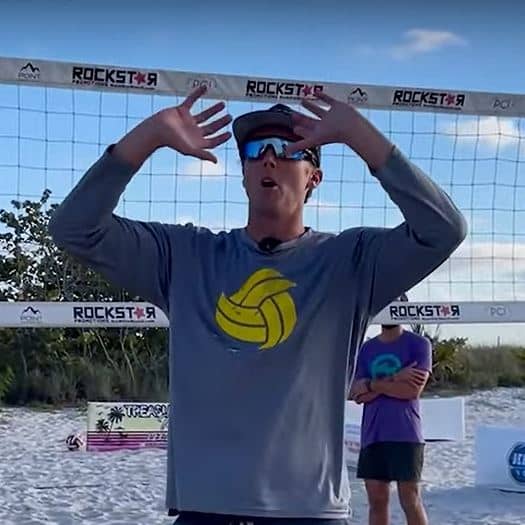
The technical standards for hand setting in beach volleyball focus a lot on a clean release of the ball. Although spin in itself is not a fault, beach players are trying to set the ball with no spin, and in practice, spinning balls simply are going to be whistled more often than not.
We’ve learned that you do get to contact the ball longer in beach volleyball than indoor. On the flip side, you’ll be judged more harshly when it comes to double contacts.
Indoor sets can spin a lot and still be legal
Especially since the last few years, an indoor setter will almost never be called for a double anymore.
The officials have agreed to allow loose setting contacts, because this will speed up the game and make it even more exciting for the fans. Also, for spectators who don’t know volleyball very well, it’s not always clear why the play was stopped when the referee has called a double touch.
3. ‘Choose your technique’ vs ‘uniform style’
Beach volleyball really has no standardized technique for hand setting.
Some players take the ball higher, some lower. There are faster and slower contacts. The set can be performed as more of a full-body movement with a lot of help from the legs. It can also be almost all hands and fingers doing the work, like indoors.
These large individual differences in execution are accepted in the beach volleyball community and by referees.
Much less so in the indoor game: Setters are taught a more uniform technique, where they’re contacting the ball in a quicker motion, above their forehead, with stiffer fingers, and relatively less bend in their elbows.
4. Hand setting has always been optional in the beach game – in indoor, you absolutely need it
Many female, and some male beach volleyball players have been, and some still are, exclusively bump setting.
They see it as the safer option and they might be almost as accurate with it as players who hand set.
Indoor players only ever bump set in emergencies
In indoor volleyball this would be unthinkable. Setters are using their hands in 98% of cases – otherwise, you could not run a proper volleyball offense.
5. Tactical differences
Speaking of offensive tactics, the two types of volleyball also differ in what type of attacking plays are commonly used.
Jump setting is coming to the beach, but it’s nowhere near indoor level
Jump setting is the standard in higher-level indoor volleyball.
Up until the last few years, you would rarely see a beach player jump set. This is changing with the rise of the Swedish youngsters. More and more teams are now adding the jump setting offense to their game as well.
Still, it’s nowhere near the indoor game – where the setter will jump on almost all passes but the very worst ones.
Different sets and offensive plays
Likewise, the best beach teams have been speeding up their offense and starting to use some deceptive sets and attacking approaches.
But beach volleyball will never have the variable offense of the regular game — simply because the setter can choose between up to five attackers. This allows for so many plays that can’t be done in a doubles match.
Learn beach setting technique as an indoor player
If you’re looking to dial in your hand setting skills for the beach, I recommend you check out the article ‘Beach Volleyball Setting 101’. In it you'll start learning the proper way to set the ball in the sand, step by step.
What are the basic hand setting mechanics you need to master?
Four mechanics fix most hand sets: set your hands early, square up and face your target, keep your weight moving forward, and hold your finish. Each one is explained below.
Basic Hand Setting Mechanics That You Absolutely NEED to Know In Order to Master Hand Setting!
Hand setting in volleyball is one of the hardest skills to master. Check out the video linked at the bottom of this blog to see some of our Better at Beach players working on hand setting with Coach DJ and hear his feedback! “Volleyball is mechanics," he explains. "It’s getting used to doing the same motion” over and over again in order “to get more reps [the correct way] in a row." This will train your body to do it correctly every time (or at least more often than not). So what are the proper mechanics for hand setting in volleyball? Keep reading to find out!
Set your hands early:
Your hands should be in ball-shape before you ever touch the ball. You should not have to quickly change the shape of your hands right before you set. Make a diamond with your two forefingers and thumbs, then spread your hands apart so they are wide enough apart that your palms will not touch the volleyball in between your hands, but close enough together so that you can hold the ball with both thumbs, pointer fingers and middle fingers. Your hands should be firm but relaxed, fingers open, and ball-shaped (your hands are just a little basket for the ball to fit perfectly into). Your elbows should be wide enough to keep your thumbs far apart and wrists flexible; when your thumbs get underneath the ball, they get in the way and make the setting motion very awkward.
Square up / Face your target:
Your feet, hips and shoulders should be facing towards where you want your set to land; this is what we call “squaring up.” We often see players facing sideways, perpendicular to the net. This will usually lead to your set being too far off the net. You want to lead your hitter forwards with your set, putting the ball in between your hitter and the net. The easiest way to lead your hitter is to face your target, squaring up to the antenna, before you set the ball. (Squaring up to the antenna is a standard starting point, but this may change based on where the pass goes, where your hitter wants to hit from, or the direction of the wind.)
Furthermore, if your body is facing the direction that your set is going to travel in, it makes it easy for your hitter to predict where the set is going to go; thus, it is easier for them to get their feet to the ball and generally produce a better attack! Sure, you can face perpendicular to the net and then side-set to get the ball towards the net, but this creates a harder set for your hitter to hit. Your goal as a setter should be to make your hitter's job as easy as possible.
Weight forward:
The weight or momentum of your body should be forward, pushing into the ball. (Ever seen Phil Dalhausser set? Almost every time, he falls forward, ending up on his knees after the set leaves his hands). Imagine an arrow going through your body, starting at your hips, going up through your chest, and the point of the arrow coming out of the top of your head. You do not want this arrow pointing straight up towards the sky; you want this arrow to be pointing diagonally, slightly forward in front of you.
If your torso stays straight up, you will either set straight on top of your own head, or even behind you. By keeping your weight forward, you can easily push the set away from you. This makes it simple to run different types of sets (such as a "push" or "pin" set) while looking the same, so the opposing team cannot predict your set.
Hold your finish:
Your arms should be fully extended at the end of your set; your elbows should not be bent. We call this the Superman Finish because your arms are extended out in front of you above your head, like Superman when he is flying. And, you should hold our arms in this Superman position for what feels like a long time (in reality, it is maybe just 1 full second) after the set leaves our hands.
Holding your finish promotes a long, slow contact. You do not want to get rid of the ball too quickly; you do not want to pull our hands away right as the ball leaves our hands because that promotes a fast touch on the ball. Fast touches are less consistent and less repeatable (and this applies to passing/digging and bump setting as well as hand setting).
Check out Coach DJ providing some FANTASTIC hand setting feedback to these Better at Beach players.
What are the 7 deadly sins of hand setting in beach volleyball?
Most illegal or ugly sets come from seven repeat mistakes — from “dainty lady hands” to slapping, balloon catching and crab hands. Here is each sin and the proper setter’s contact that replaces it, so your sets come out clean instead of dirty.
Hand setting in volleyball can be a challenge until you’ve mastered proper technique.
We clock a lot of hours every month coaching beach volleyball and it turns out there are 7 common mistakes players make again and again in their hand sets. Overcoming these 7 deadly sins on the court can make the difference between crushing it in a match or getting crushed.
To help, we’ve put together this video demonstrating the 7 deadly sins of volleyball hand setting, but more importantly, proper technique that puts you in charge of the volleyball – and ultimately the court. So don’t be the player with “dainty lady” hands, or a slapper. A balloon catcher, or ol’ “crab hands.”
Be sure to check out our other beach volleyball training videos for coaching tips from pro volleyball players. Lots of good stuff to learn and review. You’ll find great volleyball drills and clear, entertaining explanations on how to do everything correctly.
Also visit us at Better at Beach or better still, sign up for one of our beach volleyball training sessions. Solid information. Serious fun.
See you at the beach – on the court!
Video transcript below:
Hey guys, we are going to go over a few setting mistakes that a lot of people make. We coach a lot of beach volleyball hours every month. We'll say that to be safe, but we see some mistakes that are just consistent. Lots of people are making them and we thought this video would help you out and make sure that you're not making any of these crucial mistakes.
Hey wait one second before we get going. Make sure you click below. Click the subscribe button so you can be notified whenever we make a video. Okay. You're good. Sweet. Thanks. We've got a lot of names for the first mistake, so I'm just going to give you all three:
We can call it the dainty lady purse hands or princess hands. Basically, it's when you let your wrist fold over. After you're done setting, it almost looks like you're shooting basketball, but we're not. We're setting in volleyball, so don't set like this. We could call it rabbit hands, too. When you're setting, you want to finish the same way that you start. You start in a ball shape. So that's how we're going to finish. Check out my hands on the finish.
Just in that even ball shape, but with hands together.
The next one that we're going to cover is called the slapper. Whenever you're doing the slapper, it means that you are not thinking about being kind to this ball. You're going up and you're just getting that ball away from you as quick as you possibly can. Let's take a look.
An easy fix for this is to be nice to this ball. Love the ball, okay? So when that ball is coming to you late, love that. Love it. It's okay to let that ball come into your hands a little bit. Cradle it like you would if you're trying to not let an egg break, okay? And then once you've cradled it, then you can push that ball.
Next mistake we see with a lot of beginners is called the balloon catcher. This is when you see somebody running around like they're trying to bring a balloon back from the stratosphere. It's not biodegradable. When you're preparing for a set, you really want to prepare in your catch position, which I like to call the cheeseburger position where your hands are right next to your mouth and that's going to be your catch position right there. If you start too high, sometimes you get a contact up there, you're going to bring the ball down while contacting it and then send it back up and somebody's going to want to call it a lift and then you're going to get into an argument. You don't want you to do that
The next issue has to do with what we like to crab hands or changing a light bulb. Okay? The issue is that our hands look like this to where our thumbs are coming forward or to mimic what a crab would look like. Okay? We don't want to be a crab.
The easy fix for this is just to pull your thumbs away from the rest of your fingers. Or as I like to say, point your thumbs at yourself. So make sure whenever you're going up to get that ball, you are pulling your thumbs away from you to allow for that nice easy cushion. A lot of this is going to have to do with the inside of that finger. If you never let it touch this part of your hand or this knuckle, it's probably not going to be a good set. So when we have this space, that's what we don't want when we allow it in so that it just barely kisses this part of your knuckle or the inside of your fingers. You hold it on the finger pads. So if you notice my thumbs or back toward my face, allowing for that ball to land very nicely, almost like I'm making my hand into a hammock for that ball.
Mistake number five is called stone hands.
You want to make sure that your hands have some play as if they're acting like a trampoline so that the ball comes into your hands and then out. There's a little optical illusion that happens when people set. People think that they take the ball down with their elbows and then press it back up. It's actually an optical illusion. Your hands receive the ball but your elbows don't bend and then they go up. So there has to be a lot of hand and wrist action to absorb this.
You can practice that set without moving your elbows and seeing how you do.
Problem number six is called the peekaboo. A lot of times when either we don't trust our strength or we're just starting to handset, we really shorten this touch. One thing that we always want to think about when we're setting is we don’t want to give our attacker as much information as possible and when we make this really quick touch and then we pull our hands away, our attacker doesn't really know what they're looking at. So we want to make this set really, really long and we want to have our finish toward where our hitters’ contact point is going to be. One thing that is really easy to relate to an NBA player shooting a free throw. Okay. If they're shooting a free throw, they'll go through their motion and then they'll hold that hand up there as long as they need to and sometimes they'll even walk back to their side of the court. So one thing that we want to think about is really having a long finish and finishing toward our target, not making it really short.
The last one is an homage to my boy Joe. We call it the Rockaway. Lean back, lean back. We want to make sure that we stand tall throughout our set and we approach them off from behind. Most of the time people are leaning back because they've come too far under the ball and their torso or their head once they get them in the right position. Your feet should be doing that for you, so you should step behind the ball and then come forward and through it so that you end up in a nice extended position with your back leg.
***
If you want to set perfect every time, keep reading. We are going to help you set with more accuracy, more consistency and more confidence! Get the positioning and the mechanics to control the second touch with a bump set AND with hand sets! You’ll also learn to develop a mindset that makes you WANT to set every ball! NO MORE NERVOUS SETTING. All you have to do is sign up for our Beach Volleyball Mastery. We take you through the basics and then work all the way up to pursuit path, foot sequencing, rhythm and advanced offensive play sets so you put every ball in the perfect spot for your hitterWe’ll show you how to set when you’re scrambling and how to control the ball in the wind. Once inside the membership, you’ll be able to unlock “How to Set in Beach Volleyball: The 30 Day Blueprint for Superior Setting" which will build your footwork and touch from the ground up. It comes complete with footwork and agility drills, solo drills and partner exercises that can all be done at home! We also include with 9 more skill courses AND our 60 Day At-Home Max Vertical Jump Training Program.Once you sign up, you'll be able to watch the in-depth tutorials, film your “before” videos, start and film your at-home drills and begin posting to our Private Community. Then, our coaches will break down your mechanics, footwork and touch at our weekly online meetings. Yes, that means we look at YOUR videos and we coach YOU! SIGN UP NOW AND LEARN HOW TO WIN FROM THE PROS.
What is a bump set — and when should you use one?
A bump set is a set delivered on your forearm platform instead of your hands. It is completely legal, immune to double calls, and the right choice in heavy wind or off a tough pass: platform straight with hands together, net foot forward, square to your target.
Bump setting in volleyball is one of the most essential techniques you can master. It is a relatively simple skill to conquer, that you need to have in your bag of tricks at all times.
Using your forearms to bump the ball is one of the two main methods of setting the ball in beach volleyball.
In this guide, you'll learn all about it and how to do it right.
What Is A Bump Set In Volleyball?
Bumping has historically been the most popular way of setting your partner up for an attack.
It's less risky than using your hands, and still offers good accuracy. It has been the dominant technique especially in the women's game.
Windy days cause the hand set without spin to drift and dance and wiggle.
On breezy days, it’s useful to be equipped with a bump set where you can intentionally throw top spin on the ball to hold it in place rather than having it ripped this way and that.
More recently, fewer professional players are exclusively bump setting.
This is because of two main factors:
- The setting rules have been relaxed over the years, making using your hands easier
- The game is becoming faster and has more attack variations. The classic underarm technique is not suitable for this style of play
The How-To Of Bump Setting
Key Points To Remember for a great bump set:
1. Platform straight and hands together
This is a technique that should be the exact same as passing in volleyball. It is important that you hold your hand tight and keep your arms straight throughout the entire process of the set, just as you would the pass.
2. Net foot forward
When approaching the ball to set, you should think about getting your net foot forward. The reason we say ‘net foot’ is because throughout a play you may have your left foot or right foot forward depending on what side of the court you are on. There are two reasons why this is going to be important.
First, it will allow you to develop a rhythm to your bump set because you will be moving from your back foot to your front foot, allowing your energy to end up on your front foot during contact. This rhythm will make your technique replicable while also allowing your hitter to pick up on your rhythm which will make the set easier for them to get to.
Second, it will allow you to accomplish key No. 3.
3. Square to Target
Unlike passing, where your shoulders should be square to the net, bump setting is going to be easiest when you are square to your target. You should always try to finish a set with your belly button facing your attacker. If you are able to be square while setting then you have made the skill as easy as you can relying on a straight pass/set.
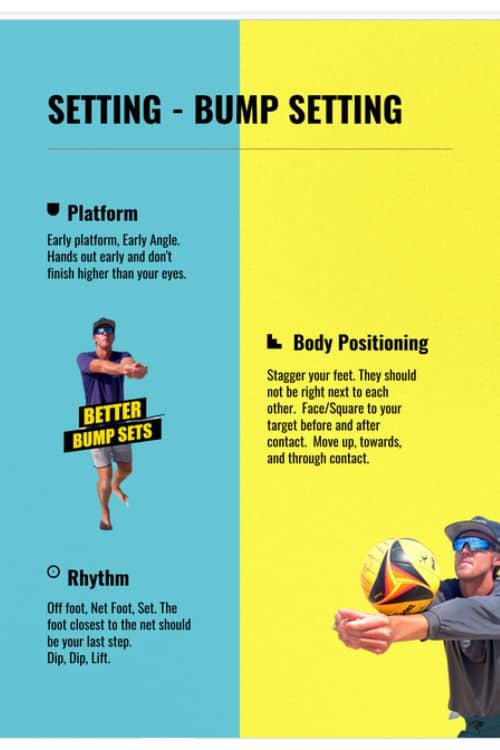
Our 30-Day Blueprint does cover both hand setting and bump setting, by the way.
If your goal is to become the best beach volleyball setter you can, quickly -- then I encourage you to check it out:
What are the 9 keys to being an excellent setter in beach volleyball?
Face your target, keep your sets off the net, talk to your partner, get more reps than anyone, learn to bump set, warm up with the triangle setting drill, finish facing forward, set about three feet off the net, and cover your hitter.
However, you don't have to wait for one of our beach volleyball classes to start learning the fundamentals. We mainly teach sand volleyball but if you play indoor volleyball, fear not! The principles and drills are almost exactly the same for bump setting and hand setting in the two sports.
Yes, the first thing nearly every coach preaches is pass first, pass first, pass first. There’s a reason for that: Every single offensive action you could possibly take, whether in serve receive or defense or waiting for the beloved free ball, begins with the pass.
Yet it’s the second – and likely most underrated – portion of the play that is most crucial: the set. It doesn’t much matter if your partner is the greatest or worst passer in the world if you can’t set. A good setter makes life easier on his partner. A great setter makes in system passes almost a lock for a side out. An exceptional setter turns out of system plays in system – a nightmare for good servers and the opposing defense.
Here are nine ways to become the sauciest setter on the beach:
1. How to set a volleyball better? Easy. Face your target
Name one sport – just one – where precision is key and you don’t face your target. When shooting a basketball, you face the hoop; throwing a baseball, you finish with your arm towards the target; golf you rotate to the point that your bellybutton is facing exactly where you want the ball to end up; tennis, same thing. This will not only invariably make the set more accurate, but it’ll show your partner exactly where you’re intending the set to end up, making the approach and ensuing side out easier and more consistent. This is one of the most important volleyball tips for beginners but even the NCAA women's beach volleyball athletes and professionals train this skill every single day.
Player to watch: AVP / FIVB Beach Volleyball Pro, Rafu Rodriguez
2. Keep your sets off the net
Given that first piece of advice, this shouldn’t be too surprising. If you’re on the net, and therefore setting sideways or backwards, you’re not going to be facing your target. Be patient with your partner’s pass, stay off the net, face your target.
3. Talk to your partner
You may have thought you just dished some I Can’t Believe It’s Not Butter – but your partner may have thought otherwise. Talk after every point, whether your partner sided out or not. The more you communicate, the more you can dial in the exact set they need, the more points you score, the more you win games, the more you win matches.
4. Set…and set…and set
This is the easiest skill in the game to practice, because all you need is a living room, a Netflix binge, and a ball. Phil Dalhausser perfected his hand setting while watching movies. Now he’s the best setter in the world. Bring a ball with you wherever you go – work, your bed, living room, waiting for your crock pot to finish that sweet barbeque chicken you love – and set. If you're struggling with the volleyball hand position and you think you are doubling a lot. This is the best tool on the market.
5. Learn to bump set
Windy days cause the hand set without spin to drift and dance and wiggle. On breezy days, it’s useful to be equipped with a bump set where you can intentionally throw top spin on the ball to hold it in place rather than having it ripped this way and that.
Player to watch: Sean Scott
6. Warm up with triangle setting drill every practice
The most efficient drill in beach volleyball: triangle setting. One hitter, one passer, one setter. Warm up with 10 bump sets and 10 hand sets on the left and the right – you’re going to have to play both, you may as well learn how – and you’ll be saucing in no time.
7. Finish facing forward
While the theatrical sets look cool on YouTube and Instagram, they aren’t very useful. The more boring your finish on your set is, the better and more consistent it’s going to be. Finish with your shoulders and belly button still facing your target. There are lots of fun volleyball drills for kids you can do. You can make them laugh AND teach them how to set a volleyball better just by telling them to make sure their belly buttons never look away from their target.
Player to watch: Jake Gibb
8. Set three feet off the net
Yes, bouncing balls in hitting lines looks awesome. It just doesn’t look so awesome when your trap set your partner looking for the glory bounce and it gets roofed 15 times. If you want to learn how to set a volleyball the right way, give your hitter some room, no less than three feet off the net. If they can’t hit it from that far off, then your teammate has something to work on in practice and they can always come to us for some private lessons.
9. COVER!!
Yes, a key to being a good setter is being humble enough to understand that, sometimes, your sets aren’t going to be a juicy three feet off the net, and it’s your job to bail them out when you put them too tight. If you have volleyball tryouts coming up, a player who covers their hitter is a coach's dream! If you want to win a CBVA or AVP America tournament, you're going to need a partner and they'll stick around if you bail them out of big blocks. You won't have to go looking for a new one on the volleytalk or VolleyChat forums if you stick with our advice.
Team to watch: Paolo Nicolai, Daniele Lupo
If you REALLY want to learn how to set a volleyball better, check out our online video courses at BetteratBeach.com. This one is great for beginners but if you are looking for some more advanced volleyball drills and practice plans, we recommend the Main Draw Membership.
TRY VOLLEYBALL DRILLS LIKE THIS ONE at every practice. Trust me when I say EVERY AVP AND FIVB PRO does this drill on the regular.
Edited by Mark Burik
This was originally written by Travis Mehwhirter who is a rising AVP Star, Host of SANDCAST Podcast and Contributing Writer for Volleyballmag.com
***
How far from the net is the perfect set?
About three feet (roughly an arm’s length) off the net. Tight sets get gobbled up by big blockers and force errors; sets kept off the net give the hitter the whole court. Whatever you call a perfect one — nectar, butter, sauce or a juicy McNugget — here is where the best players in the world want it.
Beach volleyball partners can argue a lot, but I'd like to save you a fight and teach you how to set and where the best players in the world prefer to get set. This video does look at some great players with big verticals and quick arms which means they can hit sets hard and down from far away.
Most volleyball players try to overcome their lack of accuracy in their spikes by hitting hard. If you're a shorter player or you don't have a massive vertical jump, it can be frustrating to hit balls that aren't on top of the net because you never get the feeling of hitting down.
In the video below, we show you examples where there is a big physical blocker at the net, which means tight sets will be gobbled up. At levels below AVP, FIVB CBVA open beach volleyball tournaments, I understand that blockers and hitters aren't as big so you might want to set A LITTLE bit tighter than in this how to set video but remember, even without a blocker, aiming your sets tight during a beach volleyball match means that you are going to give the team a lot of over-sets and your spiker will be forced into a desperate reaching poke more often than not.
As we say in beach volleyball over and over again, "practice safe sets"!
As always, we'd love to see you at our beach volleyball classes in Los Angeles. We are centered in Hermosa Beach but you can find beach volleyball tournaments and accommodations in Redondo Beach and Manhattan Beach. Of course, if you come to one of our epic adult beach volleyball camps or exotic trips, we handle the hotel part for you :)
How do you train to supercharge your sets?
Four training pillars: perfect your technique, get massive repetition, drill your footwork, and demand accuracy on every ball. The sections below give you the exact progressions.
PERFECT YOUR TECHNIQUE
REPETITION
FOOTWORK
ACCURACY

The Art of Proper Beach Volleyball Setting
Ever found yourself wanting to play beach volleyball yet unsure of the proper setting technique?
If so, you’re not alone. Nearly every level of athlete struggles with keeping the ball in play due to the difficulty of setting a beach volleyball.
How to Hand Set in Volleyball
The main goal of any setting action is to move the ball within the opposition's court so that attackers can effectively score. In order to do this, you must use a variety of techniques and strategies to keep the ball in play. When setting, proper hand placement is essential. Tracking the ball after the pass is essential. Preparing to set the volleyball can be challenging.
When completing a hand set, make sure to extend your arms and wrists upward to get maximum power. It is also important to keep your arms behind the ball throughout the entire setting action. To gain more power, it is important to involve your legs and torso. drive the ball up and out, using the lower body as your main source of power. To gain a better understanding of the proper setting techniques be sure to check out the Better at Beach Website for a deeper dive into the Art of Beach Volleyball Setting.
Watch as Mark Burik walks you through the best explanation of setting in volleyball.
What are the quick checklists for bump setting and hand setting?
If you only remember a handful of cues, remember these key points for each technique and the perfect set location.
Bump Setting - Key Points to Remember
Bump setting is basic and safe. This is when you set the ball using your forearms rather than your hands. For many players, bump setting is squarely in the comfort zone–and there’s nothing wrong with that! Hand setting has a few more pitfalls, so we encourage players to stick with bump setting unless they’re consistently able to set 7 out of 10 balls clean, hand setting.
Hand Setting - Key Points to Remember
While handsetting has some daunting potential pitfalls, it also gives you a lot of control in the situation. If you’re able to consistently hand set the ball, hand setting allows you to get consistent results that can translate to more successful hits for your team.
Which setting topics have their own full guides?
Some setting skills deserve their own deep dives. Read these next:
- Volleyball Rules: What’s legal (and what isn’t) with hand setting — doubles, lifts and every hand setting rule.
- Can you setter dump in beach volleyball? — the on-2 attack rules and tactics.
- Why jump setting is taking over beach volleyball.
- Every drill you need to become the best beach volleyball setter — the complete setting drill book.
How do I get coaching on my setting?
The fastest way to fix your sets is coached reps with feedback. My complete setting course — How to Set in Beach Volleyball: The 30-Day Blueprint — is inside the Better at Beach membership, and the $1 seven-day trial gets you all of it for a week ($49/month or $497/year after). If you want in-person lessons, our beach volleyball camps are essentially multi-day classes: $599 for 3 days of training with a coach-to-player ratio of 1:10 or better.