Beach Volleyball Camps for Juniors: How a Parent Should Choose (2026)
If you're a parent Googling "college beach volleyball camps" right now, you've probably noticed the pattern: every camp page promises exposure, elite coaching, and a shortcut to a roster spot. I run camps for a living, so believe me when I say — most of those pages are selling you a weekend, not a pathway.
I've spent years coaching juniors who want to play in college, and talking with their parents about where the money actually moves the needle. So here's the guide I wish every parent had before writing a camp check: what a camp can genuinely do for a college-bound athlete, what it can't, and the questions that separate serious programs from expensive beach days.
First, the honest part: what one camp can and can't do
Here's the math nobody puts on their sales page: hundreds of thousands of girls play high school volleyball, and there are only a very limited number of college beach volleyball roster spots. The families that land those spots are almost never the ones who found a magic camp. They're the ones who built a consistent, year-round development plan — and used camps as checkpoints inside it.
A good camp can do three things for a junior: compress months of technical correction into a few days, show her what the standard actually looks like against other serious players, and give you — the parent — a clear read on where she really stands. What a single camp cannot do is get her recruited. Anyone who implies otherwise is selling the dream, not the work.
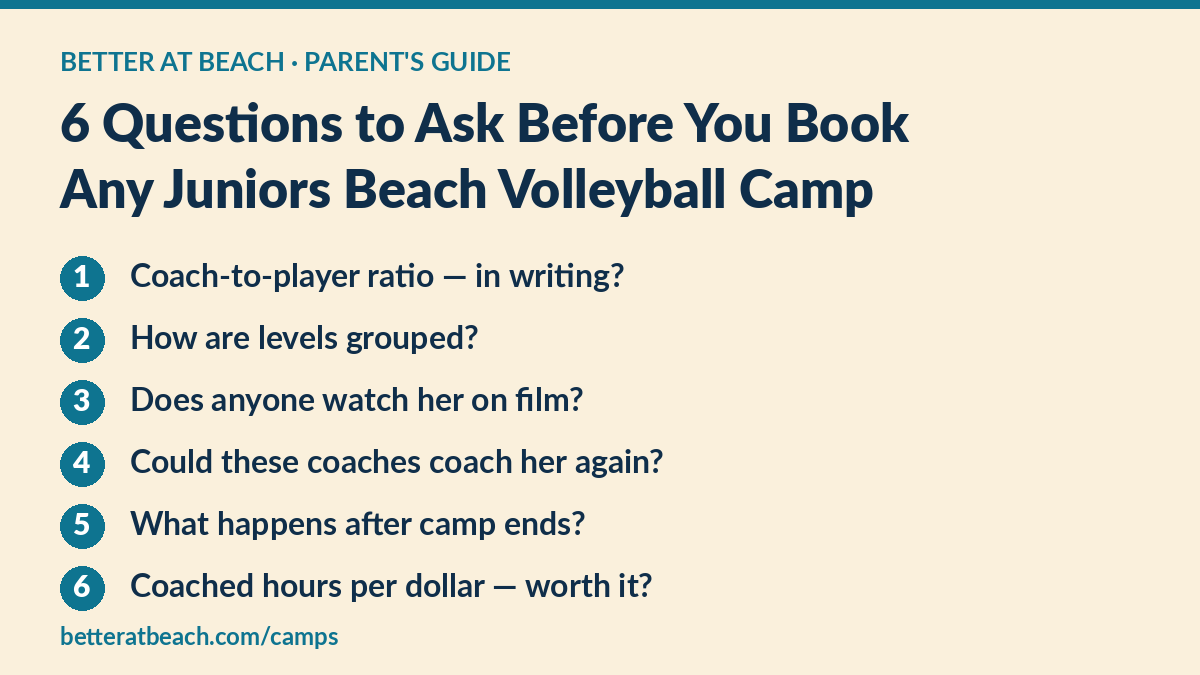
The 6 questions to ask before you book any juniors camp
1. What's the coach-to-player ratio — in writing? If a camp won't commit to a number, assume it's high. At our camps the hard cap is 12 players per coach — and we aim for 10 or fewer. Past that kind of ceiling, your daughter is paying for supervised open play.
2. How are levels grouped? The fastest way to waste a camp fee is putting a club-level athlete in a group with first-timers. Ask exactly how they sort players and whether she can move groups mid-camp.
3. Does anyone actually watch her on film? College coaches evaluate on video. If your athlete has never had a coach break down her own film, she's guessing at what recruiters see. Ask whether film review is available (at our camps, video analysis is an optional add-on — I'd rather tell you that plainly than hide it in fine print).
4. Who are the coaches — and could they coach her again next month? A big-name guest coach she'll never see again is a photo op. Continuity of coaching is what compounds.
5. What happens after the camp ends? This is the question almost nobody asks, and it's the most important one. If the answer is "nothing, see you next summer," the gains evaporate in about three weeks.
6. Does the price make sense against the alternatives? Our 3-day camps run $599 — about what 8–10 private lessons cost. Judge every camp the same way: coached hours per dollar, at the right level, with follow-up.
Here's what our camps look like from the inside, so you can compare honestly:
What actually moves the needle: coaching that doesn't stop
After years of watching juniors develop, the pattern is boringly consistent. The athletes who break through aren't the ones who attended the most camps — they're the ones who had a coach continuously in their corner: watching their film, correcting their training, and adjusting the plan as they grew.
This is exactly what that looks like. A real coaching session, a real athlete's film, a real correction plan — not a highlight reel:
And here's the kind of frame-by-frame breakdown we do on player film — arm swing mechanics, positioning, timing:
When a coach watches your kid's film and tells her precisely what to fix — and then checks whether she fixed it — improvement stops being a hope and becomes a schedule.
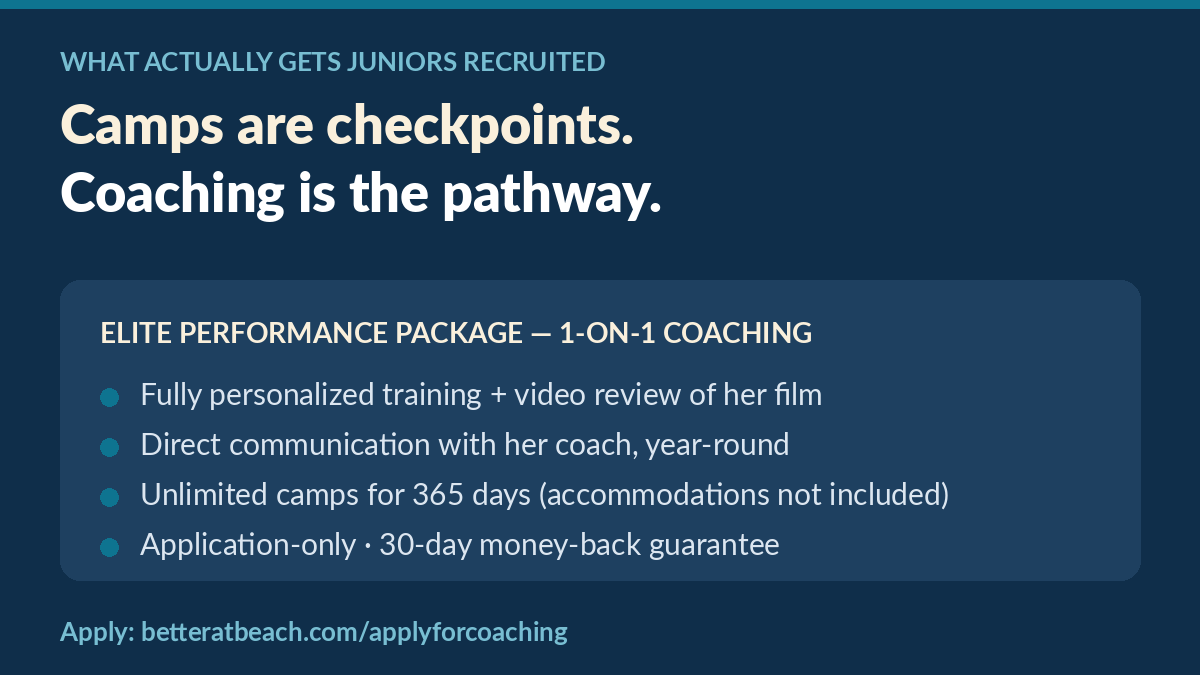
How we work with college-bound juniors
For serious athletes — club players, high schoolers targeting college beach, athletes already competing who need the last 20% — we offer an Elite Performance Package: my 1-on-1 coaching program. It includes fully personalized training, video review of her film, direct communication with her coach, and unlimited access to our camps for 365 days (accommodations not included). It's $3,497 one-time, or 3 payments of $1,200, with a 30-day money-back guarantee.
Two honest caveats, because I'd rather lose a sale than a family's trust:
- It's application-only, and acceptance isn't guaranteed. I keep the roster small enough to actually coach. The application asks about her level, goals, and schedule — I'm looking for intermediate-to-advanced athletes on a high school, club, or NCAA-bound path who will genuinely put in about 3 hours a week.
- If she's earlier in her journey, don't start here. Start with our online training membership — it's a $1 trial for 7 days, then $49/month — and a camp when she's ready. That's the right ladder, and it's a fraction of the cost.
If she's ready for 1-on-1 coaching, you can apply for the program here. If it's not the right fit, I'll tell you — and point you to what is.
The bottom line for parents
Camps are a tool, not a ticket. Pick them with the six questions above, be skeptical of anyone promising exposure, and remember that the families who win the recruiting game are the ones who buy continuity — a coach who's still watching in November, not just in July. That's the whole reason my 1-on-1 program bundles year-round coaching with unlimited camps: because that combination is what I've watched actually work.
See you on the sand — and bring sunscreen for yourself, too. Camp days are long.
— Mark